What the job is
A backend developer builds the part of a product that users do not see. That means APIs, business logic, databases, background jobs and the connections to other services.
When a user taps "Pay" in an app, backend code:
- 1
Checks the request
- 2
Talks to the payment provider
- 3
Writes the order to a database
- 4
Sends the confirmation
Data and reliability
The work is mostly about data and reliability. A backend developer asks: what happens
Two requests at once
When two requests arrive at once
A slow database
When a database is slow
A partner API outage
When a partner API is down
A traffic spike
When traffic doubles
Job titles to search
Titles vary. Search for all of these:
- Backend Engineer, Backend Developer, Backend Software Engineer
- Software Engineer, Backend and Senior Software Engineer, Backend
- Language titles: Java Developer, Python Developer, .NET Developer, Go Engineer
- Platform Engineer or API Engineer, where the "customer" is other engineering teams
- Member of Technical Staff, Backend at some AI companies
The Backend Developer market now
Work format
- On-site 50%
- Hybrid 30%
- Remote 21%
Openings by level
Where the jobs are








Read the market before you apply
The panel above shows open Backend Developer listings right now. Use it to make three decisions.
Where to look
Backend roles cluster in a few large tech metros. San Francisco and New York usually lead the city table. If you cannot move, check the remote share. It is higher for backend than for most engineering roles on our board.
Which level to target
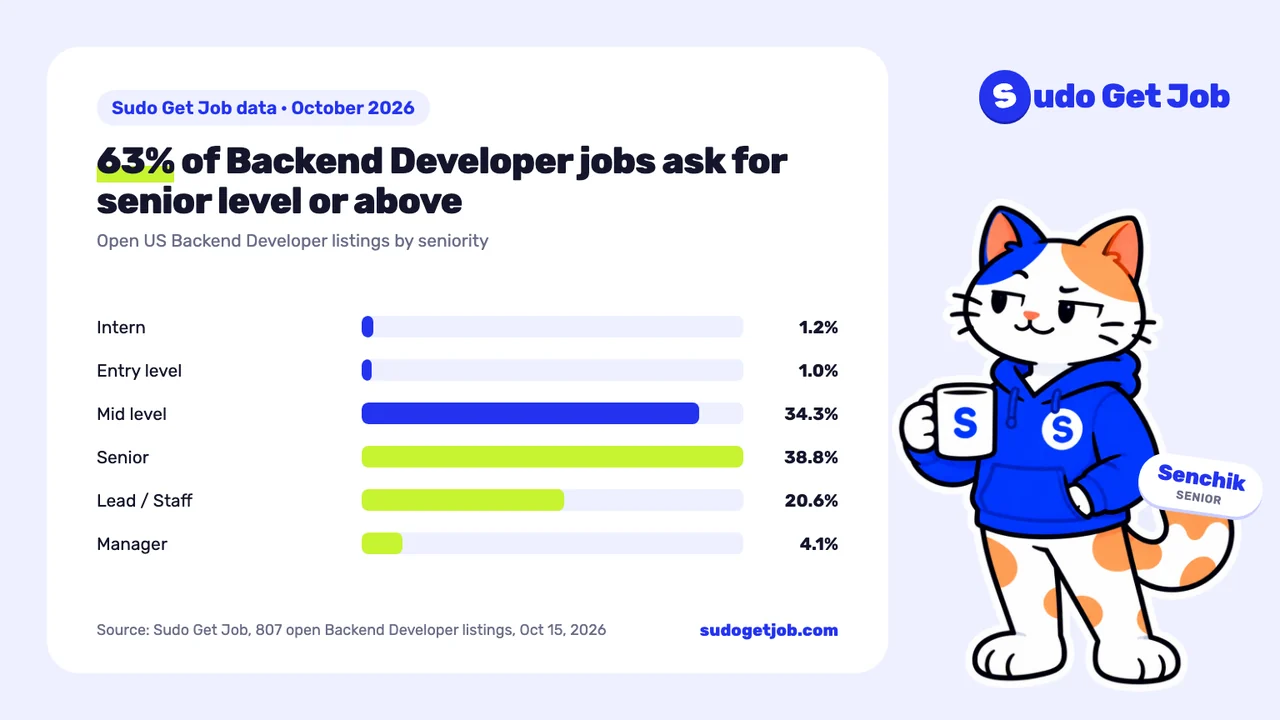
The level chart shows that backend hiring leans senior. When we checked our listings in October 2026, entry-level and intern postings together made up only a few percent of backend roles. If you are new, the section on breaking in below matters more than anything else in this guide.
What pay to expect
The median and the middle 50% come from salary ranges that employers posted. Open the Backend Developer salary page to see the same numbers by level and city.
Skills employers screen for
Backend postings list long stacks. The decisions rest on a few things.
One server-side language, well
Share of our backend listings that named each language when we checked:
TypeScript with Node.js, C# with .NET, Kotlin, Rust and Ruby also appear.
Pick one and go deep. Know its concurrency model, how it handles errors, how you test it and how you profile a slow function.
Databases
Every backend role touches data. PostgreSQL was the database named most often in our backend listings. Learn SQL well: joins, indexes, query plans, transactions and isolation levels. Know when a NoSQL store fits better and what you give up. Know what Redis is used for: caching, rate limits, short-lived data.
APIs
Learn how to design a clean REST API:
- Resources
- Status codes
- Pagination
- Versioning
- Idempotency for retries
Many companies also use gRPC between internal services or GraphQL for client apps. Know how authentication works with tokens and OAuth.
Distributed systems
Distributed systems appeared in close to four in ten backend listings when we checked. In practice this means services that talk over a network and fail in partial ways.
Learn about:
- Timeouts
- Retries
- Queues
- Eventual consistency
- How to make an operation safe to run twice
Kafka appeared in about one in five backend listings. Microservices appeared in about a quarter.
Cloud and deployment
AWS was named in close to half of our backend listings. GCP and Azure also appear. Backend developers usually deploy their own services. Learn Docker, the basics of Kubernetes and how a CI/CD pipeline takes code from a merge to production.
Observability
When your service breaks at night, logs, metrics and traces are how you find out why. Know how to add useful log lines, what a latency percentile means and how a dashboard in a tool like Grafana or Datadog helps you debug.
AI features
Some backend postings now mention LLMs or AI agents. Usually this means calling a model API from a service, handling slow and failing responses, and storing results.
Build proof of skill
A backend portfolio has no screenshots. You have to make the work visible in other ways.
Build one service that looks like production
It should have an API, a real database, authentication, tests, a migration, a Dockerfile and a deployed URL. Add rate limiting or a background job queue. One project like this is worth more than ten tutorial apps.
Write a README that reads like a design note
State what the service does, the data model, the main trade-offs and what would break first under load. Hiring managers read this to see how you think.
Show testing and failure handling
Include integration tests against a real database. Show what happens when a downstream call times out. These are the details reviewers look for.
Contribute to backend open source
Small fixes to a web framework, a database driver or a library you use show that you can work in someone else's codebase.
Measure something
Load-test your service with a simple tool, find the bottleneck and fix it. Write up the before and after. This gives you a real performance story for interviews.
Write a resume that survives screening
Keep the format plain
One column, standard headings, a common font. Parsing software skips tables, graphics and text in images.
Lead with systems and scale
Backend bullets should say what the system did and at what scale, using numbers you actually know: requests per second, data volume, number of services, uptime.
Write bullets as action, scope and result
"Moved order processing to a queue, which removed timeouts during sales peaks" tells a reviewer what you built and why it mattered.
Match the posting's words
If the posting says "Go", "PostgreSQL" and "Kafka", use those exact words where they are true for you.
Link to code
Put GitHub next to your email. Pin the repositories you are ready to discuss line by line.
Where to apply
Apply on the employer's site, and early
Every job on our board links to the employer's own application page. Sort by newest and filter for jobs posted in the last 7 days. Our report on how old open tech job posts are shows why freshness matters.
Search by stack
If you are strong in one language, search it directly: Python jobs, Java jobs or Go jobs. A strong match on stack gets more interviews than a broad search.
Look beyond tech companies
Banks, payment companies, retailers and government contractors all hire backend developers. The hiring table above usually includes several of them.
Ask for referrals
A referral from someone who knows your work usually gets your resume read by a person. Send them the exact job link and a short note on why you fit.
How the interview process works
Backend loops look like general software engineering loops, with more weight on systems.
Recruiter screen
Background, location, level and pay. Know your salary range before the call.
Technical screen
Live coding over video or an online assessment. Some companies give a practical task instead: build a small API endpoint, fix a bug in a given service or write a SQL query. Talk through your approach, then test your code with a small example.
Onsite or final loop
A typical backend loop includes:
One or two coding rounds
A system design round
Common prompts are a URL shortener, a rate limiter, a payment flow, a notification system or a job queue
A data round in some companies
Schema design, query tuning or a migration plan
A behavioral round
About projects, incidents, conflict and ownership
For system design, use a fixed structure:
- 1
Requirements
- 2
Rough scale
- 3
API
- 4
Data model
- 5
High-level design
- 6
Then bottlenecks and failure cases
Salary and negotiation
Know what the ranges mean
Several US states, including California, Colorado, Washington and New York, require pay ranges in job postings. The range is base pay. Bonus and equity come on top and vary a lot.
Set your number from data
Use the Backend Developer salary page to see the median and middle 50% by level and city. Check the remote backend salary data if you search remotely.
Ask about level
Level sets your scope, pay band and next promotion. Ask how the company levels backend engineers and where the offer sits before you negotiate the number.
Negotiate the whole offer
If base pay is fixed, ask about signing bonus, equity, title or start date. Ask in writing. A competing offer is the strongest lever.
Breaking in at entry level
Entry-level backend roles are rare. Most backend developers start in another role and specialize.
- Apply to general software engineer internships and new-grad roles, then choose backend work on the team
- Start as a full stack developer or web developer and take the server-side tickets
- Move from QA engineer, data engineer or DevOps roles, which already touch backend systems
- Build one production-like service and be ready to explain every design choice in it
Finding a remote role
Backend is one of the more remote-friendly engineering roles on our board. See all remote Backend Developer jobs. Our report on where remote tech jobs are shows how it compares with other roles.
Remote backend teams depend on writing. In interviews, mention:
- Design documents you wrote
- How you hand off work across time zones
- How you share on-call duties
A short checklist
- Choose your main language and your target level.
- Pick the cities, or remote, where you will search.
- Set a salary range from the median for your level and city.
- Build one production-like service with tests, a database and a deployed URL.
- Write a README that explains the data model and trade-offs.
- Rewrite your resume around systems, scale and results.
- Apply early on employers' own sites, searching by your stack.
- Practice system design with a fixed structure and a focus on failure cases.
- Prepare a story about a production incident.
- Ask about level, then negotiate the full offer in writing.
Start with the current Backend Developer jobs, newest first.