
What the job is
A software engineer designs, writes, tests and maintains code that runs a product or an internal system. The work is mostly reading code, changing it safely and explaining your changes to other people. Writing new code from scratch is a smaller part than most job seekers expect.
Job titles to search
Employers use many titles for the same work. Search for all of them:
- Software Engineer and Software Developer
- Software Development Engineer (SDE), common at large tech companies
- Member of Technical Staff, common at AI labs and some startups
- Application Developer, common at banks, insurers and government contractors
- Programmer, mostly at older or non-tech employers
The Software Engineer market now
Work format
- On-site 68%
- Hybrid 19%
- Remote 14%
Openings by level
Where the jobs are
| Metro | Jobs | Median |
|---|---|---|
| San Francisco Bay Area, CA | 3,270 | $223K |
| New York, NY | 1,196 | $225K |
| Seattle, WA | 725 | $222K |
| Washington, DC | 724 | $167K |
| Los Angeles, CA | 626 | $175K |
| Austin, TX | 355 | $192K |
| Boston, MA | 307 | $179K |
| Denver, CO | 266 | $182K |
| Remote, US | 1,442 | $182K |






Read the market before you apply
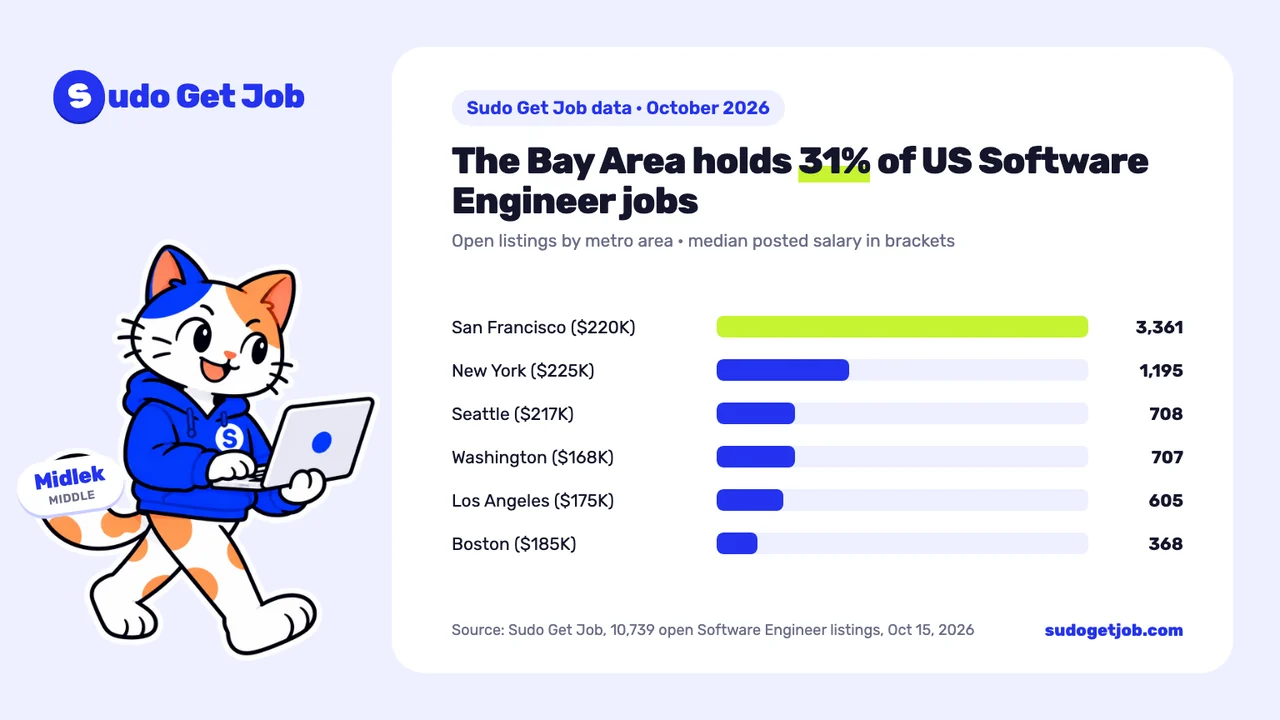
The panel above this guide shows the current market from our live listings. Use it to make three decisions before you write a single application.
Where to look
The city table shows where open roles are concentrated. If you can relocate, a metro with many openings gives you more interviews per week. If you cannot, check the remote share and the hybrid jobs in your own metro.
Which level to target
The level chart shows the mix of openings. Read the requirements, not just the title. A "Software Engineer II" at one company is a mid-level role. At another company the same title can sit closer to entry level.
What pay to expect
The median and the middle 50% range come from salary ranges that employers posted. Open the salary page to see the same numbers by level and by city.
Skills employers screen for
Job descriptions list many tools. Most hiring decisions rest on a shorter list.
Fundamentals
You need one programming language you know well. Python, Java, JavaScript or TypeScript, Go and C++ all appear often in postings.
You also need working knowledge of data structures and algorithms. Interviewers do not expect you to recall every proof. They expect you to choose a reasonable structure, explain why and estimate the cost.
Working in a real codebase
Teams hire people who can ship changes without breaking things. That means:
- Version control with Git: branches, pull requests, resolving conflicts
- Writing tests and reading a failing test to find the cause
- Reading unfamiliar code and asking good questions about it
- Giving and receiving code review without taking it personally
Systems knowledge
For mid-level roles and above, expect questions about how services talk to each other.
Learn the basics of:
- HTTP and APIs
- Relational databases and indexes
- Caching
- Queues
- How a request moves through a web stack
Communication
Engineers write constantly: pull request descriptions, design notes, incident summaries, tickets.
Build proof of skill
Pick projects that look like real work
A to-do app shows little. A small service with authentication, a database, tests and a deployed URL shows a lot. So does a tool that solves a problem you actually had.
Write a README for every project
State what it does, how to run it, what you would change next. This is a writing sample as much as a code sample.
Contribute to open source
Start with documentation fixes or small bugs in a project you use. A merged pull request in a known project shows you can work inside someone else's codebase and review process.
Show your work history in code where you can
If your past work is private, describe one hard problem in detail in your resume or on a personal page. Explain the constraint, what you tried and what happened.
Write a resume that survives screening
Your resume is read twice: by software that parses it and by a recruiter who skims it. Write for both.
Keep the format plain
Use one column, standard section headings and a common font. Avoid text in images, tables and headers. Parsers often skip them.
Match the posting's words
If the job asks for "TypeScript" and "PostgreSQL", use those exact words where they are true for you. Do not paste a keyword list. Put each term in a bullet that shows how you used it.
Write bullets as action, scope and result
"Built X using Y, which cut Z" is the pattern. If you have no metric, state the effect plainly: fewer support tickets, a faster page, a release that shipped on time.
Put links at the top
GitHub, a portfolio and LinkedIn go next to your email. Make sure the GitHub profile has pinned repositories that you are willing to discuss.
Cut what does not help
An objective statement, a long list of every tool you have touched and coursework from years ago take space from your best evidence.
Where to apply and how to prioritize
Apply on the employer's own site
Every job on our board links straight to the employer's application page. That page is the source of truth. If a job closes there, it disappears here within the hour.
Apply early
Recruiters often review applications in the order they arrive. Sort by newest and use the "Posted" filter to see jobs from the last 7 days first. Our report on how old open tech job posts are shows how much of the market is older than a few weeks.
Ask for referrals at the companies you want most
A referral from a current employee usually gets your resume read by a person. Ask people you actually know. Send them the job link and a short note on why you fit.
Keep a short list
A few applications tailored to each posting beat many identical ones. Track each one: company, date, contact, stage, next step.
How the interview process works
Most US software engineering loops follow the same shape. The details vary by company size.
Recruiter screen
A short call about your background, the role, location and pay expectations. Prepare a short spoken summary of your experience. Know your salary range before the call. The section below explains how to set it.
Technical screen
Usually a live coding session over video, sometimes an online assessment. You solve one or two problems while explaining your thinking. Some companies send a take-home project instead.
To prepare, practice problems by pattern rather than by count: two pointers, hashing, trees, graphs, dynamic programming, intervals.
- Solve out loud.
- State your approach before you type.
- Test your code with a small example when you finish.
Onsite or final loop
Several interviews in one day, often virtual. A typical loop includes:
Coding rounds
Similar to the technical screen but harder
A system design round
For mid-level roles and above: design a URL shortener, a feed or a rate limiter
A behavioral round
About past projects, conflict, mistakes and ownership
Sometimes a round with the hiring manager
About team fit and goals
For system design, practice a fixed structure:
- 1
Requirements
- 2
Rough scale
- 3
API
- 4
Data model
- 5
High-level design
- 6
Then bottlenecks and trade-offs
After the loop
Salary and negotiation
Know what the ranges mean
Several US states, including California, Colorado, Washington and New York, require employers to include a pay range in job postings. That is why so many listings on our board show a salary. The range is for base pay. Bonus, equity and benefits come on top and vary a lot between companies.
Set your number from data
Look at the median and the middle 50% for your level and city on the Software Engineer salary page. The top paying companies table there shows which employers post higher ranges.
Let the posted range work for you
When a recruiter asks for your expectations, you can point to the range in the posting. Aim for the part of the range that matches your experience.
Negotiate the whole offer
If base pay is fixed, ask about signing bonus, equity, title, start date or remote days. Always ask in writing and stay polite. A competing offer is the strongest lever you can have.
Breaking in at entry level
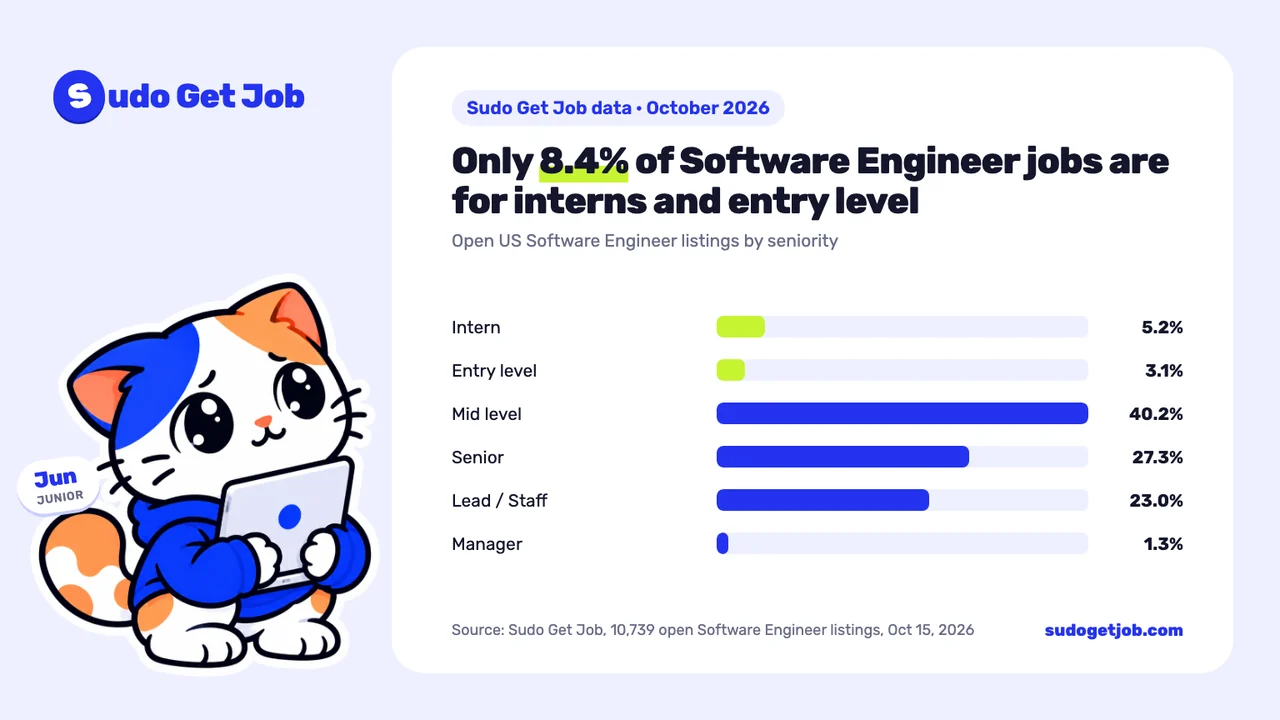
Entry-level roles are a small part of the market. The level chart above shows how small. Plan for a longer search and widen your net:
- Apply to internships and new-grad programs, which often open many months before the start date
- Look beyond tech companies: banks, retailers, healthcare systems and government contractors all employ software engineers
- Consider adjacent first roles like QA engineer, web developer or IT support and move into engineering from inside
- Build one substantial project instead of many small ones, and be ready to walk through every line of it
Finding a remote role
Remote software engineering jobs exist, but competition for them is wider because candidates apply from across the country. See all remote Software Engineer jobs and the remote salary data.
In remote interviews, written communication matters even more. Show that you can work asynchronously:
- Clear updates
- Good documentation
- Problems flagged early
A short checklist
- Choose your target level and your specialty.
- Pick the cities, or remote, where you will search.
- Set a salary range from the median and middle 50% for your level and city.
- Polish your best projects with a clear README and a live demo.
- Rewrite your resume in a plain format with action, scope and result bullets.
- Apply on employers' own sites to jobs posted in the last week or two.
- Ask for referrals at the companies you want most.
- Practice coding by pattern, system design by structure and behavioral answers by story.
- Track every application and follow up once.
- Negotiate every offer, in writing.
Start with the current Software Engineer jobs, newest first.