What the job is
An engineering manager leads a team of software engineers. Most EMs write little production code. Their output is a team that ships reliably and grows.
What an EM is responsible for
The EM is responsible for three things:
The people
The people on the team
The work
The work the team delivers
The systems
The health of the systems the team owns
Day to day
Day to day, that means:
- One-on-ones
- Hiring
- Planning
- Unblocking work
- Giving feedback
- Handling incidents
- Working with product and design on what comes next
Titles to search
- Engineering Manager, Software Engineering Manager, Manager of Software Engineering
- Senior Engineering Manager, for managers of larger teams or of other managers
- Director of Engineering, Head of Engineering, VP of Engineering at higher levels
- Development Manager or Software Development Manager, common at large companies and enterprises
The Engineering Manager market now
Work format
- On-site 68%
- Hybrid 19%
- Remote 13%
Openings by level
Where the jobs are






Read the market before you apply
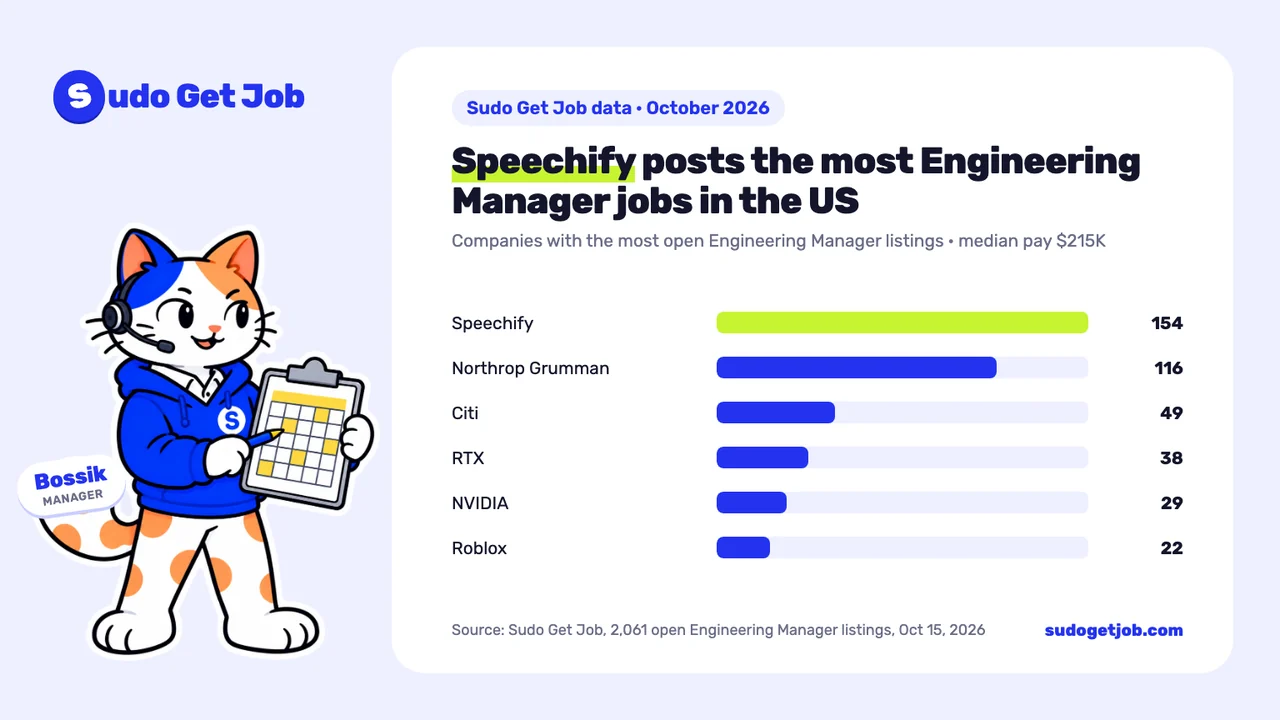
The panel above shows current Engineering Manager listings. Use it to plan.
Cities
Management roles follow engineering teams. The table shows where they are concentrated. Remote EM roles exist, but many companies prefer managers near their team or office.
Level
The level chart groups roles by seniority. For EMs, the key difference is scope: a single team, several teams or a whole department.
Pay
The median and middle 50% come from posted salary ranges. The Engineering Manager salary page breaks them down by level and city.
What employers look for
People leadership
Can you build and keep a strong team? Interviewers ask how you hired, how you gave hard feedback, how you handled an underperformer and how you helped someone get promoted. They want concrete examples with names removed.
Delivery
Can your team ship? Expect questions about planning, estimation, handling scope changes and recovering a late project. Show how you make trade-offs visible and how you keep stakeholders informed before problems become surprises.
Technical judgment
You are not the best coder on the team, but you must be able to judge technical decisions. Interviewers check whether you understand architecture, reliability, technical debt and the cost of shortcuts. Many loops include a system design round.
Cross-functional partnership
EMs work closely with product managers, designers and other engineering teams. Show how you resolved disagreements about priorities and how you share ownership of outcomes with your product partner.
Operating rhythm
Good managers run a predictable system: regular one-on-ones, planning cycles, retrospectives, on-call and incident reviews. Be ready to describe yours and why it works.
From senior engineer to manager
Most first-time EMs are promoted from inside. If you want to make the move, start before you have the title.
- 1
Lead without the title
Mentor junior engineers. Run a project across several people. Own an on-call rotation or an incident review. Each of these gives you stories for an EM interview.
- 2
Tell your manager you are interested
Ask what the company expects from a new manager. Ask to cover for your manager when they are away, or to run hiring for an open role.
- 3
Learn the people side deliberately
Practice giving specific feedback. Learn how performance reviews work at your company. Read about one-on-ones, delegation and difficult conversations.
- 4
Decide if you want it
Management is a different job, not a promotion of the same one. Many strong engineers stay on the individual contributor path as staff or principal engineers. Talk to managers you trust about what they gave up.
Write an EM resume
Show team outcomes
Each role should state what the team delivered under your leadership and what changed for the business or for users.
Show people outcomes
Hires made, people promoted, attrition reduced, teams formed. If you cannot share numbers, describe the change plainly.
Show scope
Team size, number of teams, systems owned, budget if relevant. Scope is how hiring managers place you at the right level.
Keep a technical line
List the stack and the architecture your team worked with. EM hiring managers still want to know you understand the technology.
Format plainly
One column, standard headings, no graphics. It parses well and reads quickly.
Where to apply
Apply on the employer's site, early
All jobs here link to the employer's own application page. Filter for recent postings first. Management roles may stay open longer than individual contributor roles, but early applications still get more attention.
Use your network more than for any other role
EM hiring depends on trust. Former managers, peers who moved companies and recruiters you have worked with are your best channels.
Choose the stage that fits you
Startups want managers who also build process from scratch. Large companies want managers who can work inside existing process and ladders. Be clear which you are.
Check the team, not just the company
Ask who you would report to, how big the team is, how long the role has been open and why it is open.
How the interview process works
EM loops are usually longer than engineering loops. A typical sequence:
Recruiter screen
Background, scope of past roles, motivation, location and pay.
Hiring manager conversation
A director or VP checks your leadership approach and whether your experience matches the scope. Prepare a clear summary of the teams you led and what changed under you.
People management interviews
The center of the loop. Expect scenario and behavioral questions:
- An engineer is missing deadlines and the team is frustrated. What do you do?
- Two senior engineers disagree strongly on an architecture choice. How do you resolve it?
- Tell me about someone you hired who did not work out.
- How do you help an engineer get promoted?
- How do you handle a team member who wants to become a manager?
Execution and delivery interview
How you plan quarters, handle changing priorities, manage dependencies and communicate risk. Be ready to walk through a project that went wrong.
System design or technical interview
Many companies keep a design round for EMs. You might design a system or review an architecture. The bar is judgment and trade-offs, not perfect detail.
Cross-functional interview
Often with a product manager or designer. They want to know if they would enjoy working with you.
Coding round
Some companies still include a coding interview, especially for tech lead manager roles. Ask the recruiter in advance and prepare if needed.
Prepare for your first months
Interviewers often ask what you would do when you join. A good answer shows that you listen before you change things.
- 1
Meet everyone one on one
Ask each engineer what is working, what is not and what they want from their career.
- 2
Learn the systems
Read the architecture docs, the on-call runbooks and the last few incident reviews.
- 3
Meet your partners
Sit down with your product manager, your designer and the managers of teams you depend on.
- 4
Find one early win
Fix a small, visible problem the team has complained about for a long time.
- 5
Write down what you learned
Share a short summary with your manager and your team, with the changes you plan and why.
Salary and negotiation
Read the posted range
Several US states, including California, Colorado, Washington and New York, require employers to post pay ranges. Many EM listings here show one. It covers base pay. Bonus and equity are often a large part of manager pay, so ask about them.
Use level and city data
The Engineering Manager salary page shows medians by level and by metro, and which companies post the highest ranges.
Negotiate scope as well as pay
Team size, headcount budget, reporting line and title affect your next career step. Clarify them before you sign.
Ask about the management ladder
How are managers evaluated? What does promotion to senior manager or director require? A clear ladder is a sign of a company that takes management seriously.
Finding a remote EM role
Remote EM roles exist, especially at companies that are remote-first. See remote Engineering Manager jobs. Our report on where remote tech jobs are compares remote availability by role.
Managing remotely depends on written communication and a strong operating rhythm. In interviews, describe:
- How you run one-on-ones over video
- How you keep remote engineers connected
- How you spot problems without seeing people in an office
A short checklist
- Decide whether you want management or technical leadership.
- Collect leadership stories: hiring, feedback, a struggling project, a promotion you supported.
- Define your scope honestly: one team or several.
- Set a pay range from the median for your level and city, and ask about bonus and equity.
- Rewrite your resume around team and people outcomes.
- Reach out to your network before applying cold.
- Practice scenario questions out loud.
- Refresh system design.
- Ask about the team, the reporting line and why the role is open.
- Negotiate pay and scope together, in writing.
Start with the current Engineering Manager jobs, newest first.