
What the job is
A frontend developer builds the part of a product that people see and use in a browser. That means pages, forms, navigation, interactive components and everything that connects them to the server. The work is a mix of code, layout, performance and close collaboration with designers.
What good frontend work looks like
Good frontend work is invisible to users. Pages:
- Load fast
- Work on every screen size
- Respond to the keyboard
- Read well with a screen reader
- Do not break when the network is slow
Most of the job is making that true and keeping it true as the product grows.
Job titles to search
Employers use many titles for the same work. Search for all of them:
- Frontend Engineer, Front End Developer, Frontend Software Engineer
- Software Engineer, Frontend, a common title at tech companies
- UI Engineer or UI Developer
- Design Engineer at some software companies, for engineers who work very close to design
- Web Developer, more common at agencies and smaller employers
Neighboring roles
Neighboring roles have their own pages.
Full stack developer
A full stack developer works on both the browser and the server.
Backend developer
A backend developer builds the server side.
Mobile developer
A mobile developer builds native apps.
Web developer
A web developer often builds and maintains marketing sites.
UI or product designer
A UI designer or product designer designs the interface but usually does not ship the code.
The Frontend Developer market now
Work format
- On-site 63%
- Hybrid 16%
- Remote 21%
Openings by level
Where the jobs are






Read the market before you apply
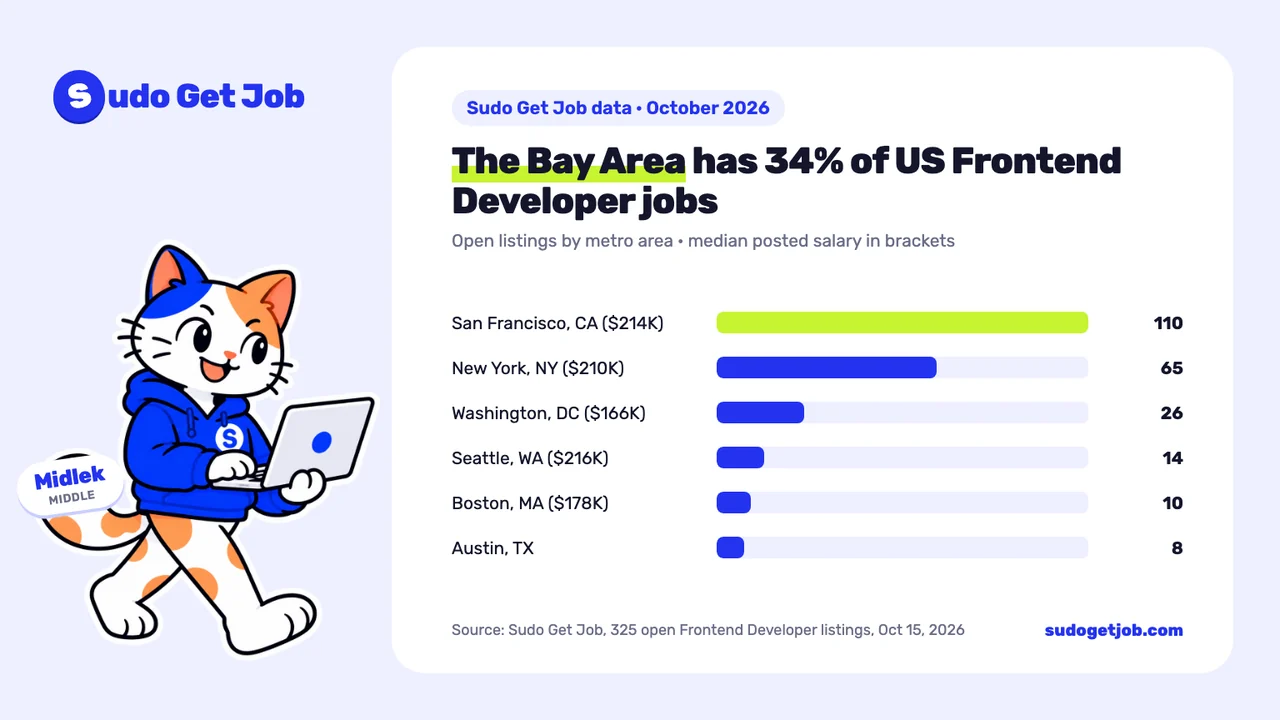
The panel above shows open Frontend Developer listings right now. Use it to plan your search, and read titles carefully.
Cities
The city table shows where openings cluster. San Francisco, New York and Seattle are strong markets for software frontend roles.
Level
The level chart shows the mix. Mid-level and senior roles make up most openings. Entry-level roles are a small share. Read the requirements, not just the title.
Pay
The median and the middle 50% come from salary ranges that employers posted. The Frontend Developer salary page breaks them down by level and city. Compare offers with listings that clearly describe frontend work.
Skills employers screen for
To see what software employers ask for, we looked only at listings with frontend, web, UI, React or JavaScript in the title. The numbers below come from that group in October 2026.
JavaScript and TypeScript
TypeScript appeared in about two out of three of those listings. JavaScript appeared in more than four out of ten, often alongside TypeScript.
Learn JavaScript deeply first:
- Closures
- The event loop
- Promises and async code
- Modules
- How the browser runs scripts
Then add TypeScript types to your projects. Most new frontend codebases use it.
React and other frameworks
React appeared in about three out of four listings in that group. It is the safest framework to learn first. Next.js appeared in close to one in five. Angular and Vue each appeared in about one in six. Angular is common at large enterprises and banks.
HTML and CSS
CSS appeared in about a third of the listings and HTML in more than a quarter. Many candidates underrate them. Employers notice.
Learn:
- Semantic HTML
- The box model
- Flexbox
- Grid
- Responsive layout
- How to debug layout problems in browser developer tools
Design systems
Design systems appeared in about three out of ten listings in the group. A design system is a shared library of components, styles and rules. Frontend developers build and maintain these libraries. Learn how to write reusable, documented components, and how to work from design files in Figma.
Accessibility
Web accessibility appeared in about one in seven listings. It means people using keyboards, screen readers or other assistive tools can use the product.
Learn the basics:
- Semantic elements
- Labels
- Focus order
- Color contrast
- ARIA used only where needed
APIs and data
REST APIs appeared in about one in five listings and GraphQL in about one in eight. You need to fetch data, handle loading and error states, cache results and keep the interface in sync with the server.
Testing and tooling
Employers expect tests. Test automation and tools like Jest, Cypress and Playwright appear in postings. Learn unit tests for logic, component tests for UI and a few end-to-end tests for key flows. Learn Git and how a CI pipeline runs your tests before a merge.
Performance
Frontend performance is a common interview topic. Learn:
- How to measure page load
- What blocks rendering
- How to split code
- How to load images efficiently
- How to find slow components
Build a portfolio that proves it
Frontend work is visible, so a portfolio matters more here than in most engineering roles.
Build fewer, better projects
One or two polished apps beat ten tutorials. Pick something with real interaction: forms with validation, data from an API, loading and error states, routing and a few tested components.
Make it work everywhere
Test on a phone, with the keyboard only and with a screen reader. Fix what breaks. Mention it in the README.
Deploy it
Every project should have a live URL. Hiring managers click links more often than they clone repositories.
Show the code
Keep the repository clean, typed and tested. Write a README that explains what the app does, how to run it and what you would improve next.
Rebuild a real interface
Recreate a complex screen from a product you use, such as a calendar, a data table or a checkout. It shows you can handle the details real products need.
Contribute to open source
Many component libraries and frontend tools are open source. A merged fix shows you can work in someone else's codebase.
Write a resume that survives screening
Keep the format plain
One column, standard headings, no graphics. Show your design sense in the portfolio, not the resume. Parsing software often skips text in images and tables.
Match the posting's words
If the job asks for "React", "TypeScript" and "accessibility", use those exact words where they are true for you. Put each one in a bullet that shows how you used it.
Write bullets as action, scope and result
"Rebuilt the checkout in React, which cut page load time" is the pattern. If you have no metric, state the effect plainly.
Put links at the top
Portfolio, GitHub and LinkedIn go next to your email.
Where to apply
Apply on the employer's site, and early
Every job here links to the employer's own application page. Sort by newest and filter for jobs posted in the last 7 days. Our report on how old open tech job posts are shows why freshness matters.
Search by skill as well as role
Many frontend jobs are titled simply Software Engineer. Searching React jobs or TypeScript jobs finds roles that a title search misses.
Ask for referrals
A referral from a current engineer usually gets your resume read by a person. Ask people you know and send them the job link.
Look beyond tech companies
Banks, retailers, media companies, agencies and healthcare companies all build web products and hire frontend developers.
How the interview process works
Frontend loops follow the general software engineering shape, with frontend-specific rounds.
Recruiter screen
Background, motivation, location and pay. Have a short summary ready of your strongest project and the frameworks you know.
Technical screen
Often a live coding session in JavaScript or TypeScript. Some companies ask algorithm questions. Others ask you to build a small component, such as an autocomplete, a modal or a paginated list. Some send a take-home project instead.
Frontend deep dive
Questions on how the browser works. Common prompts:
- "What happens between typing a URL and seeing the page?"
- "How would you make this page load faster?"
- "How does React decide when to re-render?"
- "How would you make this component accessible?"
Frontend system design
For mid-level roles and above, you design a frontend system: a news feed, a chat interface, a design system or a large form.
Cover:
- Component structure
- State management
- Data fetching
- Caching
- Performance
- Accessibility
Behavioral round
Stories about working with designers, pushing back on a design, a bug that reached users or a hard deadline. Prepare a handful of stories and be specific about your own part.
Salary and negotiation
Use posted ranges
Several US states, including California, Colorado, Washington and New York, require pay ranges in job postings. Many listings on our board include one. The range is base pay only.
Set your target from comparable roles
Use the Frontend Developer salary page for medians by level and city. Because this category includes some hardware design roles, also compare with the Software Engineer salary page and with the posted ranges of frontend listings you have checked yourself.
Negotiate the whole offer
If base pay is fixed, ask about signing bonus, equity, title, level or remote days. Always ask in writing.
Breaking in at entry level
Entry-level frontend roles are a small share of the market. Plan for a longer search and widen your net:
- Apply to internships and new-grad programs, which often open many months before the start date
- Start as a web developer at an agency or a QA engineer at a product company and move into frontend from inside
- Move from design into frontend if you already work in UX design and can learn to code
- Build one substantial, accessible, tested app and be ready to explain every part of it
Finding a remote role
Remote frontend jobs exist, but they are a small share of this category, and competition is wide. See all remote Frontend Developer jobs and the remote salary data. Our report on where remote tech jobs are shows how frontend compares with other roles.
In remote interviews, show that you work well in writing:
- Clear pull request descriptions
- Short design notes
- Screenshots or recordings that explain a change
A short checklist
- Choose your framework and your target level.
- Check titles carefully and skip hardware design roles.
- Set a salary range from comparable frontend listings in your city.
- Build one or two polished, deployed, accessible projects.
- Rewrite your resume in a plain format with action, scope and result bullets.
- Search by skill as well as by title.
- Apply early on employers' own sites, and ask for referrals.
- Practice building components from scratch and explaining browser basics.
- Practice frontend system design with a fixed structure.
- Negotiate every offer, in writing.
Start with the current Frontend Developer jobs, newest first.