What the job is
A product manager decides what a team builds next and why. The PM talks to customers, reads data, works out which problem matters most and writes it down clearly enough that designers and engineers can solve it. Then the PM makes sure the solution ships and checks whether it worked.
Job titles to search
Titles vary. Search for all of these:
- Product Manager, Associate Product Manager (APM), Senior Product Manager
- Product Owner, common in companies that run Scrum
- Group Product Manager, Product Lead or Head of Product for people who manage other PMs
- Technical Product Manager for platform, API and infrastructure products
Neighboring roles
Neighboring roles are often confused with PM.
Program manager
A program manager coordinates delivery across many teams.
Project manager
A project manager runs a defined project to a deadline.
Product marketing manager
A product marketing manager owns positioning and launches.
The Product Manager market now
Work format
- On-site 58%
- Hybrid 23%
- Remote 20%
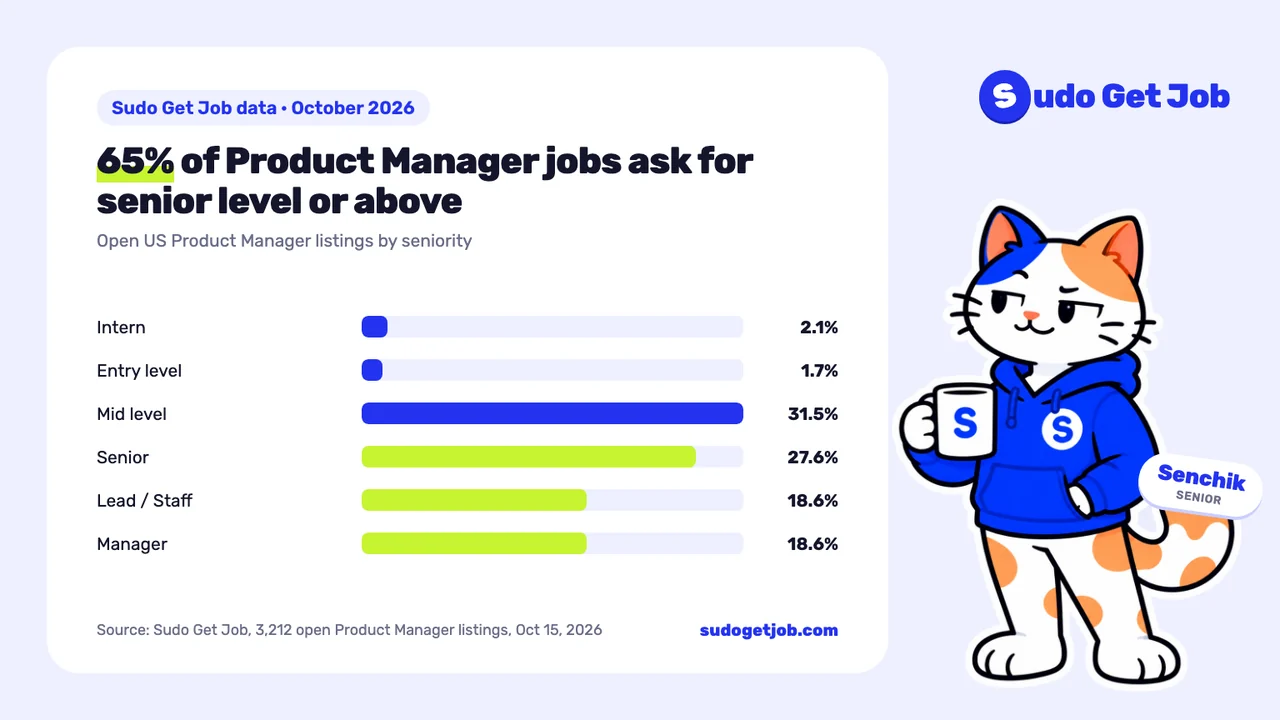
Openings by level
Where the jobs are
| Metro | Jobs | Median |
|---|---|---|
| San Francisco Bay Area, CA | 883 | $225K |
| New York, NY | 733 | $209K |
| Washington, DC | 333 | $195K |
| Chicago, IL | 195 | $200K |
| Seattle, WA | 162 | $211K |
| Boston, MA | 132 | $170K |
| Austin, TX | 97 | $200K |
| Los Angeles, CA | 90 | $201K |
| Remote, US | 612 | $189K |






Read the market before you apply
The panel above shows open Product Manager listings right now. Use it to plan your search.
Cities
PM roles cluster in a few metros. The table shows where. If you need to stay where you live, check the remote share and the hybrid roles nearby.
Level
The level chart shows the mix. Associate and entry-level PM roles are scarce at most companies. Many people enter product management from another role inside the same company.
Pay
The median and the middle 50% come from salary ranges that employers posted. The Product Manager salary page breaks them down by level and city.
Skills employers test
Job descriptions vary, but PM interviews test the same core skills.
Product sense
Can you pick the right problem? Interviewers ask you to improve a product, design one for a new user group or decide between two features.
They want to hear:
- Who the user is
- What job they are trying to get done
- What the options are
- Why you chose one
Analytical thinking
You do not need to be a data scientist. You need to define a success metric, spot when a metric is misleading and reason through a drop in usage.
Execution
Shipping requires breaking work into steps, setting priorities, making trade-offs on scope and keeping people aligned. Expect questions like "Your launch is slipping by two weeks. What do you do?" Show that you protect the most important outcome and communicate early.
Communication
PMs write a lot: product requirement documents, one-pagers, launch notes, updates for leadership. Many companies ask for a writing sample or a take-home document.
Technical fluency
You do not have to code. You need to understand how the product is built well enough to talk about trade-offs with engineers. Learn the basics of APIs, databases, client and server, and how releases work.
AI product skills
Many current PM postings mention AI features. If you apply to those roles, learn how large language model features are evaluated, where they fail and how teams measure quality. Be able to describe a feature where AI makes the product better, and one where it would make it worse.
Show product judgment without the title
The hardest part of getting a first PM job is proving you can do it. These are the usual ways in.
Move internally
If you work at a product company as an engineer, designer, analyst, support lead or consultant, ask to take on PM work: write a spec, run a small feature, own a metric. Internal transfers are a common path into product.
Own something end to end
Launch a small product or a side project with real users. Track who uses it, what they ask for and what you changed. A modest product with honest numbers is more convincing than a polished mockup.
Write product case studies
Pick a product you use. Write a short document: the user problem, the evidence, three options, your pick and how you would measure it. Put a few of these on a personal page and link them in your resume.
Use your domain
Industry knowledge is valuable in product. A former teacher understands education buyers. A former nurse understands clinical workflows. Target companies that sell to the people you used to be.
Write a PM resume
A PM resume shows outcomes, decisions and influence.
- Lead with outcomes Each bullet should say what changed because of your work: usage, revenue, retention, cost, speed, satisfaction. If you have no number, describe the effect plainly.
- Show the decision, not just the task "Prioritized X over Y based on Z, which led to W" tells a hiring manager how you think. "Managed the roadmap" does not.
- Show cross-functional work Name the teams you worked with: engineering, design, sales, legal, support. PM is a coordination role and the resume should show it.
- Keep it plain and readable One column, standard headings, no graphics. Parsing software and busy recruiters both prefer it.
- Match the posting's language If the job asks for "B2B SaaS", "experimentation" or "platform", use those words where they are true for you.
Where to apply
Apply on the employer's site, and early
Every job here links to the employer's own application page. Sort by newest and filter for jobs posted in the last 7 days. Our report on how old open tech job posts are shows why freshness matters.
Use referrals
PM hiring leans heavily on referrals. Reach out to PMs you know at target companies. Ask a specific question about their team before you ask for a referral.
Target companies whose product you understand
Your interviews will be stronger if you use the product, know its customers and can discuss its competitors.
Look beyond software companies
Banks, retailers, insurers, media and healthcare companies all hire product managers for their digital products. Competition there is often lower.
How the interview process works
PM loops differ by company but usually include these stages.
Recruiter screen
Background, motivation, location and pay. Have a short story ready on why you want to be a PM and why this company.
Hiring manager screen
A deeper conversation about your experience. Expect a product question or two. The manager is checking whether you think in terms of users and outcomes.
Case interviews
The core of the loop. Common formats:
Product design
"Design a product for X." Clarify the goal, choose a user segment, list their pain points, generate options, pick one, define how you would measure it.
Product improvement
"How would you improve our product?" Start from a user problem, not a feature idea.
Metrics
"Usage dropped last week. Why?" Check data issues first, then internal changes, then external causes. Segment by platform, region and user type.
Strategy
"Should we enter market Y?" Discuss customers, competitors, the company's strengths and the risks.
Execution
trade-offs, prioritization, handling a slipping launch.
Technical round
For many roles, a conversation with an engineer about how you would work together, how a feature might be built or how you would handle technical debt.
Behavioral round
Stories about conflict, failure, influence without authority and hard decisions. Prepare a handful of stories you can adapt. Be honest about your part and what you learned.
Take-home or presentation
Some companies ask for a written product proposal or a short presentation. Keep it focused. A clear recommendation backed by evidence beats a long deck.
Salary and negotiation
Use posted ranges
Several US states, including California, Colorado, Washington and New York, require pay ranges in job postings. Many PM listings on our board include one. The range is base pay only.
Set your target by level and city
Use the Product Manager salary page to see medians by level and metro. Check the remote PM salary data if you are looking remotely.
Entry-level and career-switch paths
Formal APM programs exist at some large companies, but they are few and competitive. Other routes are more common:
Transfer from a neighboring role
Start as a business analyst, data analyst, UX designer or engineer at a product company and transfer.
Join a startup
Join a startup where people take on several roles and product work is available.
Move from delivery
Start as a project manager or scrum master and move closer to product decisions.
Come from the customer side
Work in customer success or solutions and become the person who knows what customers need.
Finding a remote PM role
Remote PM jobs exist across many industries. See all remote Product Manager jobs.
- Remote PMs rely on writing even more than office-based PMs. In interviews, mention how you run decisions in documents, how you keep stakeholders updated and how you handle time zones.
- Check the location rules in each remote posting. Many are open only to certain states or require periodic travel.
Our report on where remote tech jobs are shows how product compares with other directions.
A short checklist
- Decide which kind of product you want to work on: consumer, B2B, platform or AI.
- Choose your target level honestly, based on the decisions you have owned.
- Set a salary range from the median for your level and city.
- Write a few product case studies and put them online.
- Rewrite your resume around outcomes and decisions.
- Apply early on employers' own sites, and ask for referrals.
- Practice product design, metrics and execution cases out loud.
- Prepare behavioral stories about influence, conflict and failure.
- Ask about leveling before you negotiate.
- Negotiate the full offer in writing.
Start with the current Product Manager jobs, newest first.