What the job is
A project manager makes sure a defined piece of work gets done on time, within budget and to the agreed scope. In tech and digital teams, that work can be a software release, a system migration, a website rebuild, a client implementation or a marketing campaign.
What a project manager does
The project manager:
- Plans the work
- Tracks progress
- Manages risks and dependencies
- Runs meetings and keeps everyone informed
How it differs from product and program management
This is different from a product manager and from a program manager.
Product manager
A product manager decides what to build and why.
Program manager
A program manager coordinates several related projects toward a larger goal.
Titles to search
- Project Manager, IT Project Manager, Technical Project Manager
- Digital Project Manager, common at agencies and in marketing teams
- Delivery Manager, common in consulting and in UK-influenced companies
- Implementation Manager, for customer onboarding at software vendors
- Project Coordinator, often the entry-level step
The Project Manager market now
Work format
- On-site 72%
- Hybrid 14%
- Remote 14%
Openings by level
Where the jobs are





Read the market before you apply
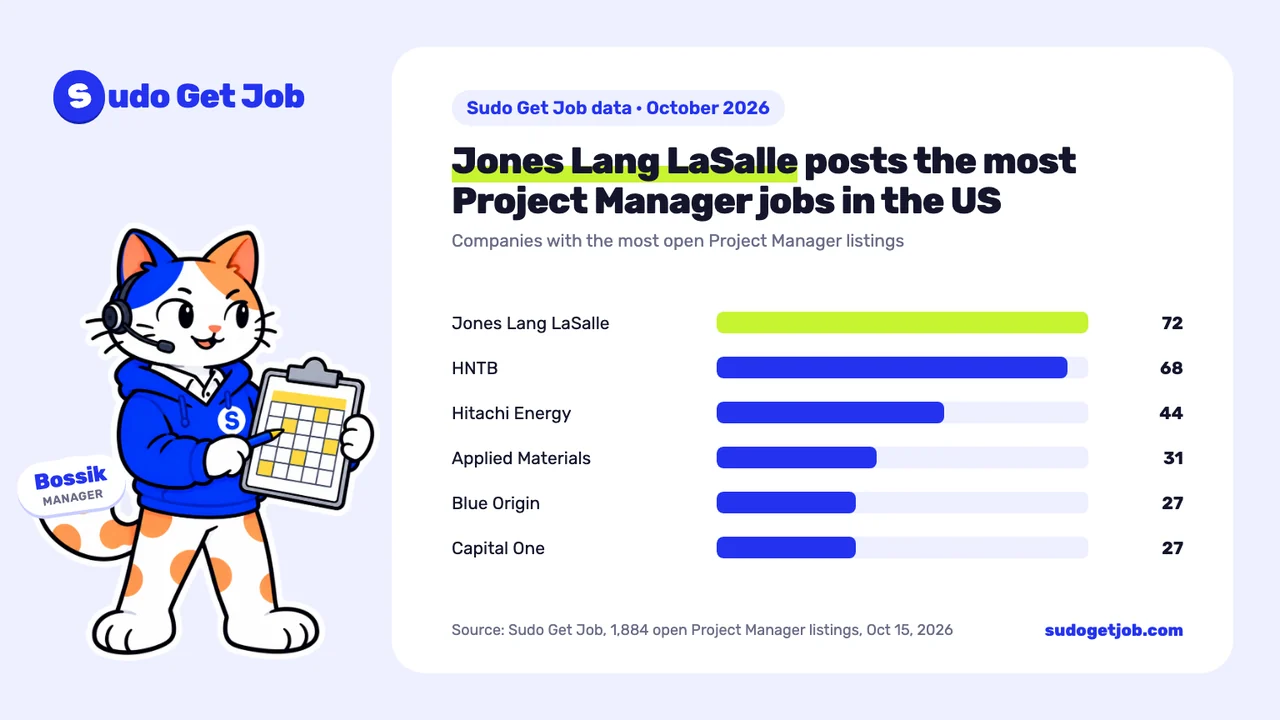
The panel above shows current Project Manager listings.
Cities
The table shows where openings concentrate. Project management is spread across many industries, so roles appear in metros that are not classic tech hubs too.
Level
The level chart shows the mix. Coordinator and junior roles are the usual way in. Senior roles expect you to run larger budgets and more stakeholders.
Pay
The median and the middle 50% come from salary ranges that employers posted. The Project Manager salary page shows them by level and city.
Industry
Read the company line in each listing. A project manager at a software vendor, a bank, a hospital and an agency do similar work in very different settings. Pick the setting that fits your background.
Skills employers look for
Planning and scheduling
You need to break work into tasks, estimate effort, sequence dependencies and build a realistic timeline. Interviewers want to hear how you build a plan with the team, not for them.
Risk and issue management
Strong PMs spot risks before they become problems. Keep a risk log.
For each risk, know:
- The likelihood
- The impact
- The owner
- The plan
Be ready to tell a story about a risk you caught early.
Stakeholder communication
You will write status reports, run steering meetings and explain bad news.
Methods: Agile, Scrum and Waterfall
Most tech teams use some form of Agile.
Scrum
Know how Scrum works: sprints, backlog, planning, stand-ups, reviews, retrospectives.
Kanban
Know Kanban.
Waterfall
Also know when a sequential, Waterfall-style plan is the right choice, for example for hardware, compliance or fixed-scope client work.
Hybrid approaches are common.
Budget and resource tracking
Senior roles often include a budget. Learn the basics of tracking actual spend against plan and forecasting the end cost.
Tools
Postings often name the tools. Common ones include Jira, Confluence, Asana, Monday.com, Smartsheet, Microsoft Project and Excel. Learn whichever tools appear in your target listings.
Technical literacy
For IT and software projects, understand the basics: how software is built and released, environments, testing, deployments and what a migration involves. You do not need to code. You need to ask good questions and spot when an estimate is unrealistic.
Certifications
Certifications matter more for project management than for most tech roles. Some employers, especially in government contracting, finance and large enterprises, list them as requirements.
| Certification | What it is |
|---|---|
| PMP | From the Project Management Institute (PMI), the best-known credential. It requires documented project experience and an exam. |
| CAPM | Also from PMI, the entry-level version for people with less experience. |
| Scrum certifications | Such as Certified ScrumMaster (CSM) from Scrum Alliance or Professional Scrum Master (PSM) from Scrum.org, show Agile knowledge. |
| PMI-ACP | Combines Agile methods with PMI's framework. |
| PRINCE2 | More common in the UK and with multinational employers. |
Show delivery experience
If you have run projects under another title, that experience counts. Teachers run school programs. Event planners run complex timelines. Operations staff run process changes. Support leads run tool rollouts.
- 1
Describe each project in project terms
Goal, scope, team size, timeline, budget if any, risks, outcome. This translates your experience into the language hiring managers use.
- 2
Pick a few strong stories
One project that went well, one that went badly and what you did, one where you handled a difficult stakeholder.
- 3
Show artifacts if you can
A redacted project plan, a status report template or a risk log shows how you work.
Write a project manager resume
- Lead with delivery For each role, list the projects you ran and their outcome: delivered on time, under budget, adopted by users, issue avoided.
- State scope Team size, budget, number of stakeholders, duration. Scope is how employers judge your level.
- Name your methods and tools Agile, Scrum, Waterfall, Jira, Smartsheet. Use the posting's exact words where they are true for you.
- Put certifications near the top if the listings you target ask for them.
- Keep the format plain One column, standard headings, no tables or graphics. It parses well and is easy to skim.
Where to apply
Apply on the employer's site
Every job here links to the employer's own application page. Filter for recent listings first. Our report on how old open tech job posts are shows the age mix of open roles.
Look across industries
Software vendors, consultancies, agencies, banks, insurers, healthcare systems, universities and government contractors all hire project managers for tech and digital work.
Consider contract roles
Many project management roles are contracts tied to a single project. They are a practical way to build experience quickly.
Use your industry knowledge
If you worked in healthcare, a health IT project role values that. If you worked in marketing, digital agency PM roles do.
How the interview process works
Recruiter screen
Background, projects, certifications, location and pay. Have a short summary of the biggest project you ran.
Hiring manager interview
Expect detailed questions about your projects. How did you plan it? What went wrong? How did you communicate with stakeholders? What would you change?
Scenario questions
Common examples:
- A key team member leaves halfway through the project. What do you do?
- The client asks for new scope without moving the deadline. How do you respond?
- Two departments disagree about priorities. How do you resolve it?
- The project is behind schedule. How do you tell leadership?
Use a clear structure:
- 1
Understand the situation
- 2
Assess impact
- 3
List options
- 4
Recommend one
- 5
Communicate
Show that you escalate early and with options.
Methods and tools questions
How you run sprints, how you handle a backlog, when you would choose Waterfall, how you track progress in your preferred tool.
Panel or stakeholder interview
Some companies have you meet the team you would support. They want to know if you will help them or slow them down.
Exercise
Some employers ask you to build a simple project plan, write a status update or prioritize a list of tasks. Keep it practical and explain your reasoning.
Salary and negotiation
Use posted ranges
Several US states, including California, Colorado, Washington and New York, require pay ranges in job postings. Many project manager listings here include one. The range is base pay.
Compare by level and city
The Project Manager salary page shows medians by level and metro.
Factor in contracts
Contract roles are often paid by the hour. Our salary figures include only annual salaries, so compare contract rates separately and remember that contractors usually pay for their own benefits.
Negotiate more than base pay
Ask about bonus, training budget for certifications, remote days and title. A Senior title can matter for your next role.
Entry-level and career-switch paths
Start as a coordinator
Start as a project coordinator or PMO analyst and move up as you take on projects.
Earn a baseline certificate
Earn CAPM or a Scrum certificate to show baseline knowledge.
Run a project where you are
Volunteer to run a project in your current job, even a small internal one.
Join an agency or consultancy
Join an agency or consultancy, where junior staff often get project responsibility early.
Try scrum master
Consider a scrum master role if your team already uses Scrum.
Finding a remote project manager role
See remote Project Manager jobs. Our report on where remote tech jobs are shows how remote availability compares across roles.
A short checklist
- Choose the industry and project type you want: software, IT infrastructure, digital marketing or client implementation.
- Check which certifications your target listings ask for.
- Write your best project stories in goal, scope, risk and outcome form.
- Set a salary range from the median for your level and city.
- Rewrite your resume around delivery and scope.
- Learn the tools named in your target listings.
- Apply early on employers' own sites, across several industries.
- Practice scenario questions out loud.
- Consider contract roles to build experience.
- Negotiate pay, title and training budget together.
Start with the current Project Manager jobs, newest first.