What the job is
A data scientist uses data to answer business questions and to build models that make predictions.
Day to day
Some days are spent cleaning data and writing SQL. Other days go to designing an experiment, training a model or explaining a result to people who will act on it.
Two kinds of work
The title covers two kinds of work.
Analytics-focused
Analytics-focused data scientists run experiments, define metrics and help product teams make decisions.
Modeling-focused
Modeling-focused data scientists build and improve prediction models, ranking systems or forecasts.
Job titles to search
Titles vary. Search for all of these:
- Data Scientist, Senior Data Scientist, Staff or Principal Data Scientist
- Research Scientist, common at AI labs and large tech companies
- Quantitative Researcher, common at trading firms and hedge funds
- Applied Scientist, used at some large tech companies
- Decision Scientist or Product Data Scientist for analytics-focused roles
Neighboring roles
Neighboring roles have their own pages.
Data analyst
A data analyst focuses on reporting and analysis.
Data engineer
A data engineer builds the pipelines and warehouses.
Machine learning engineer
A machine learning engineer puts models into production and keeps them running.
AI engineer
An AI engineer builds products on top of large language models.
Read the responsibilities, not just the title.
The Data Scientist market now
Work format
- On-site 67%
- Hybrid 19%
- Remote 13%
Openings by level
Where the jobs are







Read the market before you apply
The panel above shows open Data Scientist listings right now. Use it to plan your search.
Cities
Data science roles cluster in a few metros. The city table shows where. Washington, DC ranks high because of government and defense work. Some of those roles require a security clearance.
Level
The level chart shows the mix. Mid-level and senior roles make up most openings. Entry-level roles are scarce, and in October 2026 our board had more data science internships than entry-level jobs. If you are a student, internships are the most direct way in.
Pay
The median and the middle 50% come from salary ranges that employers posted. The Data Scientist salary page breaks them down by level and city.
Skills employers screen for
Job descriptions list many tools. Most hiring decisions rest on a shorter list.
Python and SQL
Python is the most common skill in Data Scientist postings on our board.
In October 2026:
| Skill | How often it appeared |
|---|---|
| Python | In about three out of four listings |
| SQL | In about half |
| R | In roughly one in four, often as an alternative to Python |
- You need to write SQL that joins several tables, filters correctly and handles missing values.
- You need to write Python that loads data, cleans it, fits a model and produces a chart.
Statistics and experimentation
Statistics is what separates a data scientist from someone who runs code. Expect questions on distributions, hypothesis testing, confidence intervals, regression and common mistakes like comparing many metrics at once.
A/B testing comes up in many product-focused roles. Be able to:
- Design an experiment
- Choose a metric
- Estimate the sample size
- Explain a result that looks good but is not significant
Machine learning
Machine learning appears in most Data Scientist postings on our board.
How common models work
You should be able to explain how common models work: linear and logistic regression, decision trees, gradient boosting and basic neural networks.
How to evaluate them
You should also know how to split data, avoid leakage, pick an evaluation metric and spot overfitting.
Large language models
About a quarter of our Data Scientist listings in October 2026 mentioned LLMs.
In practice this means:
- Evaluating model output
- Building retrieval or classification on top of an existing model
- Measuring whether an AI feature helps users
If you target these roles, learn how teams evaluate LLM features and where those evaluations break.
Big data tools
Spark and cloud platforms like AWS appear in a meaningful share of postings.
Communication
Build a portfolio that proves it
A resume lists methods. A portfolio shows how you think with them.
- 1
Pick real data and a real question
Public datasets are fine, but choose a question someone would pay to answer. Avoid the datasets every course uses. Hiring managers have seen them many times.
- 2
Show the whole process
Start from the question. Show how you cleaned the data, what you tried, what failed and what you concluded. A notebook that only shows the final model hides the most interesting part.
- 3
Write a short summary for each project
State the question, the data, the method, the result and its limits in plain language. This is a writing sample as much as a code sample.
- 4
Put it where people can see it
A GitHub repository with a clear README and a short write-up on a personal page is enough. Pin the projects you are ready to discuss in detail.
- 5
Use your domain
If you worked in healthcare, finance, retail or logistics, build a project in that field. Domain knowledge helps you ask better questions, and employers in that field notice it.
Write a data scientist resume
Lead with impact
Each bullet should say what changed because of your work: a decision made, revenue gained, cost cut, a model shipped, a metric improved. "Built a churn model" says little. "Built a churn model that the retention team used to target offers" says more.
Name the methods and tools
Recruiters search for terms like "Python", "SQL", "A/B testing", "PyTorch" or "causal inference". Use the posting's exact words where they are true for you.
Show scale
Mention data size, number of users affected or how often a model ran. Scale helps hiring managers judge level.
Keep it plain
One column, standard headings, no charts. Parsing software often skips text inside images and tables.
Mention your degree clearly
Close to half of our Data Scientist listings mention a PhD. Read whether the posting requires it or lists it as one option. Some roles accept a master's degree or equivalent work experience instead.
Where to apply
Apply on the employer's site, and early
Every job here links to the employer's own application page. Sort by newest and filter for jobs posted in the last 7 days. Our report on how old open tech job posts are shows why freshness matters.
Use referrals
Ask data scientists you know at target companies about their team before you ask for a referral. Ask what kind of work dominates: analytics or modeling.
Match your strengths to the role type
Strong in statistics and product thinking? Target product data science. Strong in modeling and code? Target modeling roles or consider machine learning engineering.
How the interview process works
Data science loops differ by company but usually include these stages.
Recruiter screen
Background, motivation, location and pay. Have a short summary ready of your strongest project and the kind of data work you want.
Technical screen
Usually SQL and Python, sometimes both. You may write queries against a sample schema or clean a small dataset live. Some companies send a take-home exercise instead.
Statistics and machine learning round
Questions on probability, hypothesis testing, experiment design and model choice. Common prompts:
- "How would you test whether this new feature increases engagement?"
- "Your model performs well offline but poorly in production. Why?"
- "Explain the trade-off between precision and recall for this use case."
Answer in plain words first. Add formulas only when they help.
Case or product round
For product-focused roles, a business question: "Sign-ups dropped last week. How would you investigate?" Check data issues first, then internal changes, then external causes. Segment by platform, region and user type.
Project presentation
Many companies ask you to present a past project or the take-home. Keep it short. State the question, the approach, the result and what you would do next.
Behavioral round
Stories about a project that failed, a disagreement about results, or a time you changed someone's mind with data. Prepare a handful of stories and be specific about your own part.
Salary and negotiation
Use posted ranges
Several US states, including California, Colorado, Washington and New York, require pay ranges in job postings. Many data science listings on our board include one. The range is base pay only.
Set your target by level and city
Use the Data Scientist salary page to see medians by level and metro. Check the remote data science salary data if you are looking remotely.
Negotiate the whole offer
Bonus, equity, signing bonus, title and level all matter. Ask how the company levels data scientists and where your offer sits.
Entry-level and career-switch paths
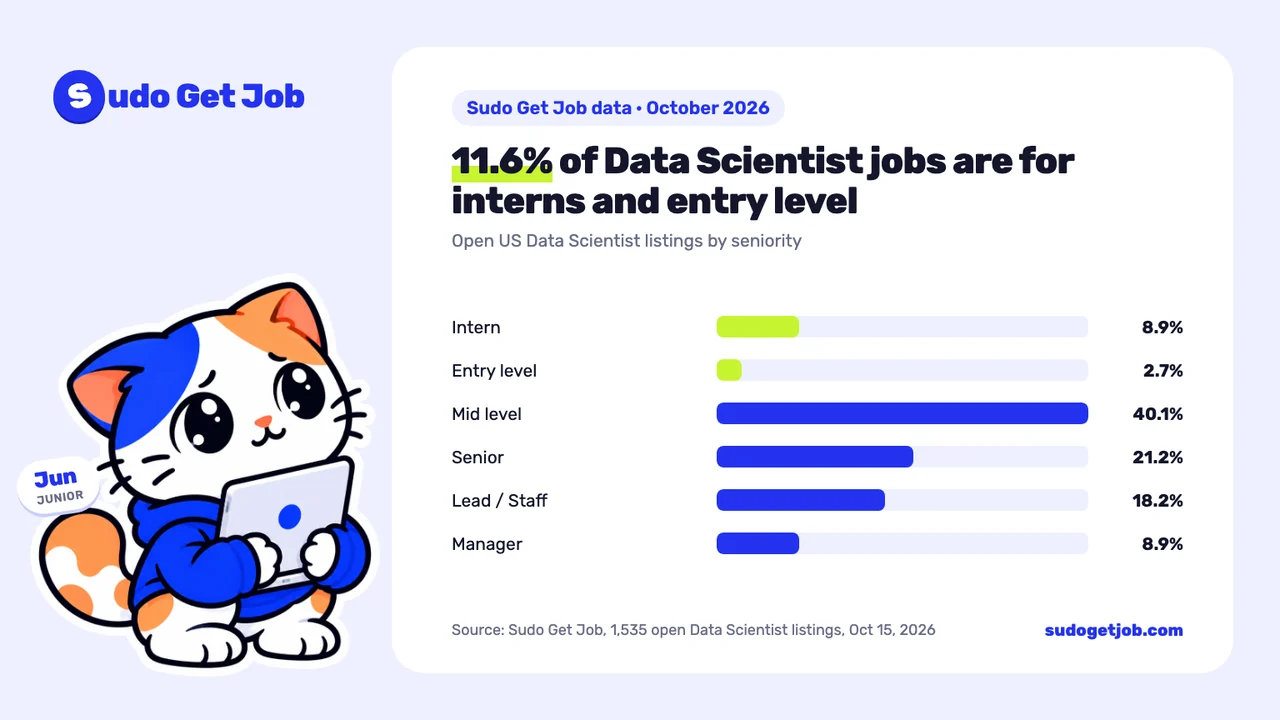
Entry-level data science roles are few. Plan for a longer search and consider these routes:
Through an internship
Apply to internships while you study. They often open many months before the start date.
From analyst roles
Start as a data analyst or business analyst and move into data science from inside the company.
From data engineering
Start as a data engineer and add modeling and statistics over time.
From a research field
Move from a research field such as physics, economics, biology or psychology, where you already used statistics on real data.
Finding a remote role
Remote data science jobs exist, but competition for them is wide. See all remote Data Scientist jobs.
Our report on where remote tech jobs are shows how data roles compare with other directions.
In remote interviews, show that you communicate results in writing: clear analysis documents, readable notebooks and short summaries for people who will not read the code.
A short checklist
- Decide which side you want: analytics, modeling or LLM-focused work.
- Choose your target level honestly.
- Set a salary range from the median for your level and city.
- Build two or three projects on real questions, with clear write-ups.
- Rewrite your resume around impact, methods and scale.
- Apply early on employers' own sites, and ask for referrals.
- Practice SQL, pandas and statistics questions out loud.
- Prepare one project you can present in ten minutes.
- Prepare behavioral stories about disagreement and failure.
- Negotiate the full offer in writing.
Start with the current Data Scientist jobs, newest first.