What the job is
A data engineer builds and runs the systems that move data from where it is created to where people and programs use it. Data comes from application databases, event streams, files and outside services. The data engineer collects it, cleans it, models it and loads it into a warehouse or lake. Analysts, data scientists, dashboards and machine learning systems then rely on it.
A typical week
The work is a mix of software engineering and data modeling. A typical week includes:
- Writing pipeline code
- Writing and tuning SQL
- Fixing a job that failed overnight
- Adding a new data source
- Answering questions about why two numbers do not match
The roles around it
The role sits next to several others.
Data analyst
A data analyst uses the data to answer business questions.
Data scientist
A data scientist builds statistical and predictive models.
Machine learning engineer
A machine learning engineer trains and serves models.
Backend developer
A backend developer builds the application that creates much of the data.
The data engineer connects all of them.
Job titles to search
Titles vary. Search for all of these:
- Data Engineer and Big Data Engineer
- Analytics Engineer, for roles focused on SQL modeling inside the warehouse
- Data Platform Engineer, for roles that build the shared tools and infrastructure
- ETL Developer, common at banks, insurers and older enterprises
- Software Engineer, Data
The Data Engineer market now
Work format
- On-site 60%
- Hybrid 21%
- Remote 19%
Openings by level
Where the jobs are




Read the market before you apply
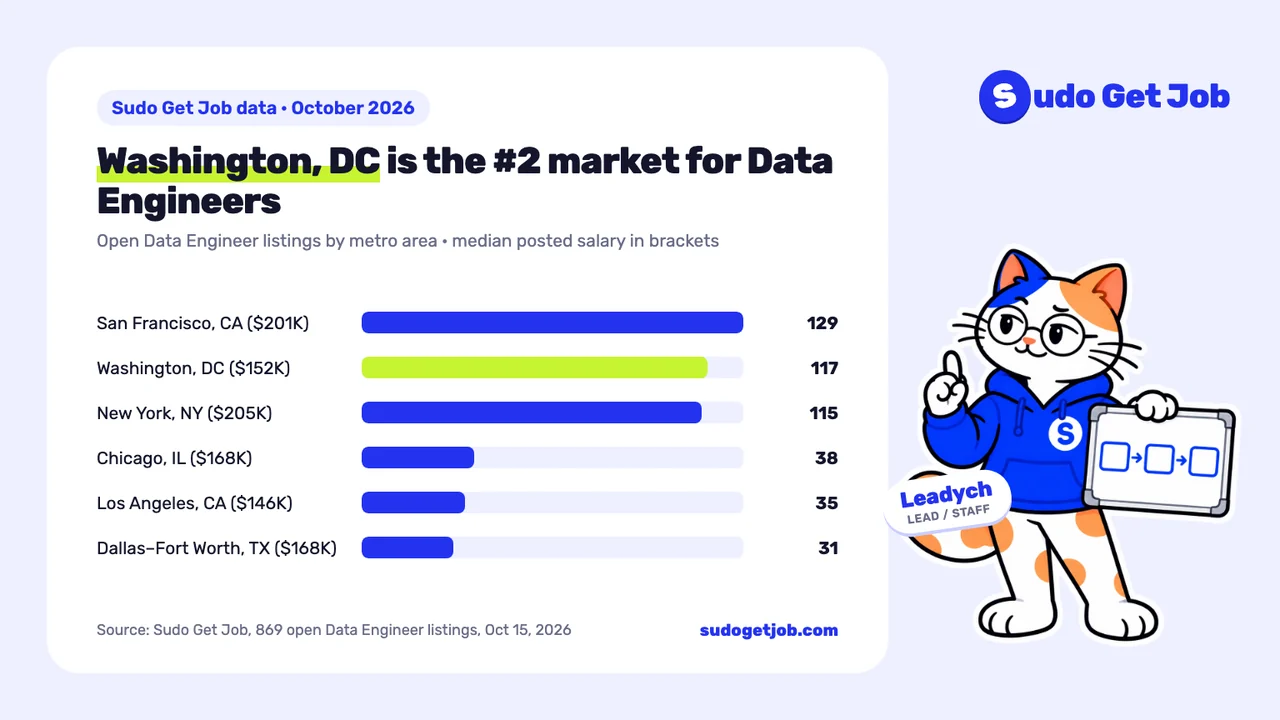
The panel above shows open Data Engineer listings right now. Use it to plan your search.
Where to look
The city table shows where roles cluster. In our listings, the San Francisco Bay Area, New York and the Washington DC region have the largest groups. Texas and Illinois follow. If you cannot relocate, check the remote share.
Remote is a real option
In our listings, data engineering currently has a larger remote share than general software engineering. Remote roles still attract applicants from across the country, so competition is wider.
Which level to target
The level chart shows the mix. Mid-level and senior roles make up most of the market. Entry-level roles are few, although internships appear more often than in some other engineering roles.
What pay to expect
The median and the middle 50% come from salary ranges that employers posted. The Data Engineer salary page breaks them down by level and city.
Skills employers list most often
We tag the skills named in each job description. For data engineer roles in our listings:
| How often | Skills |
|---|---|
| The most common | Python, SQL, AWS, ETL and data warehousing |
| Come next | Machine learning, data modeling, Spark, CI/CD and Airflow |
| Also appear often | Snowflake, Databricks, Azure, dbt and GCP |
SQL
SQL is the most important skill in the job. It appears in most of our data engineer listings, and nearly every interview tests it.
Go beyond basic queries. Learn:
- Joins of every kind
- Aggregation
- Window functions
- Common table expressions
- Subqueries
- How to handle nulls and duplicates
- How to read a query plan and explain why a query is slow
Python
Python is the language named most often in our data engineer listings. You use it to write pipeline code, call APIs, transform files and test your work. Learn to write clean, tested Python, not just notebook scripts. Know how to process data that does not fit in memory.
Data modeling and warehousing
Data modeling decides whether people can use the data. Learn fact and dimension tables, star schemas, slowly changing dimensions and the trade-offs between normalized and wide tables. Learn how data warehousing works: loading, partitioning, clustering and cost.
ETL and orchestration
ETL means extract, transform, load. Many teams now load raw data first and transform it inside the warehouse. Learn both patterns.
- How to make a pipeline safe to re-run
- How to load only new data
- How to handle late or duplicate records
Airflow is the orchestration tool named most often in our data. It schedules pipelines, tracks dependencies and retries failures. dbt is common for SQL transformations in the warehouse, with tests and documentation built in.
Distributed processing and streaming
Spark
Spark is the processing engine named most often in our data engineer listings. Learn how it splits work across machines, what causes a slow shuffle and how partitioning affects speed.
Kafka
For real-time data, Kafka is the streaming tool named most often. Learn topics, partitions, consumers and the difference between batch and streaming pipelines.
Cloud and infrastructure
AWS is the cloud named most often in our data engineer listings, followed by Azure and GCP. Learn object storage, permissions, managed data services and cost basics. CI/CD, Git and infrastructure as code with Terraform appear in many listings.
Data quality
Data for machine learning and AI
Machine learning appears in many of our data engineer listings, and LLMs in some. Data engineers often build the pipelines that feed training data, features and documents to these systems.
Build proof of skill
Data engineering is easy to show with one well-built project.
- 1
Build an end-to-end pipeline
Pick a public data source that updates often, such as a public API or open government data. Extract it on a schedule, load it into a warehouse, model it into clean tables and build one simple dashboard on top.
- 2
Use the tools employers name
For example: Python for extraction, Airflow for scheduling, dbt for transformation and a cloud warehouse for storage. Keep costs low and say how.
- 3
Add tests and checks
Data quality checks, unit tests for transformation logic and a CI pipeline. This is what separates a real pipeline from a tutorial.
- 4
Make it re-runnable
Show that you can rerun a day of data without creating duplicates. Interviewers ask about this often.
- 5
Write a README
Explain the sources, the data model, the schedule, the checks and what you would change at larger scale. Include a diagram.
Write a resume for data engineer roles
Lead with your stack
A short skills line near the top: SQL, Python, warehouse, orchestration tool, processing engine, cloud. Recruiters scan for these words.
Show scale and reliability
Data volume, number of sources, number of pipelines, run time before and after, failures reduced. If you have no number, describe the effect plainly.
Show who used the data
For example: built the pipeline behind the finance team's daily revenue report. That tells a hiring manager the work mattered.
Match the posting's words
If the job asks for "Snowflake", "dbt" and "Airflow", use those exact terms where they are true for you.
Keep the format plain
One column, standard headings, no graphics. Link your pipeline project at the top.
Where to apply
Apply on the employer's site, and early
Every job here links to the employer's own application page. Sort by newest and filter for jobs posted in the last 7 days. Our report on how old open tech job posts are shows why freshness matters.
Look beyond tech companies
Banks, insurers, retailers, healthcare systems, media and logistics companies all depend on data pipelines. Competition there is often lower.
Use your domain
A data engineer who understands finance, healthcare or supply chains can model the data correctly the first time. Target industries you already know.
Ask for referrals
Reach out to data people you know at target companies. Ask about their stack before you ask for a referral.
How the interview process works
Data engineer loops usually include these stages.
- 1
Recruiter screen
Background, stack, location and pay. Be ready to describe one pipeline you built in two minutes: the source, the tools, the scale and who used the result.
- 2
SQL screen
Almost every data engineer loop has one. Expect several questions of growing difficulty: joins, aggregation, window functions, finding duplicates, ranking within groups and computing running totals. Write clean SQL and talk through edge cases like nulls and ties.
- 3
Coding round
Usually Python. Some companies use standard algorithm problems. Others give a data task: parse a file, transform records, merge two datasets or process data in chunks.
- 4
Data modeling round
You design tables for a business. For example, an online store or a ride-sharing app. Clarify what questions the business needs to answer. Then choose fact and dimension tables, keys and how history is stored. Explain trade-offs.
- 5
Pipeline design round
Design a pipeline end to end: sources, ingestion, storage, transformation, orchestration, data quality and monitoring. Discuss batch versus streaming, how to handle late data and how to recover from a failure.
- 6
Behavioral round
Stories about broken pipelines, wrong numbers, disagreements with analysts and work you automated. Prepare a few. Be honest about your part and what you changed afterward.
Salary and negotiation
Use posted ranges
Several US states, including California, Colorado, Washington and New York, require pay ranges in job postings. Many data engineer listings on our board include one. The range is base pay only.
Set your target by level and city
Use the Data Engineer salary page for medians by level and metro. Check the remote salary data if you are searching remotely.
Ask about on-call
Some data teams run on-call for failed pipelines. Ask how often, and whether early-morning failures fall on you.
Negotiate the whole offer
Bonus, equity, signing bonus, title and remote days all matter. Ask in writing and stay polite.
Breaking in
Entry-level data engineer roles are few. The level chart above shows how few. These paths are more common:
From data analyst
Start as a data analyst and take on pipeline and SQL modeling work.
From business analyst
Start as a business analyst at a data-heavy company and move toward the warehouse.
From software engineering
Start as a software engineer or backend developer and join a data platform team.
Through an internship
Apply to data engineering internships, which open months before the start date.
Finding a remote role
See all remote Data Engineer jobs. Our report on where remote tech jobs are shows how this role compares with others.
- Read the location section of every remote posting. Many remote roles are limited to certain states or time zones.
- In interviews, show that you document your pipelines and data models clearly. Remote teams depend on written documentation to trust the data.
A short checklist
- Get strong at SQL, including window functions and query plans.
- Learn Python for pipelines, with tests.
- Learn data modeling and one cloud warehouse.
- Learn one orchestration tool and one transformation tool.
- Build and document one end-to-end pipeline with data quality checks.
- Set a salary range from the median for your level and city.
- Rewrite your resume around scale, reliability and who used the data.
- Apply early on employers' own sites and ask for referrals.
- Practice SQL, data modeling and pipeline design out loud.
- Negotiate every offer in writing.
Start with the current Data Engineer jobs, newest first.