
What the job is
A machine learning engineer builds systems that train, serve and monitor models in production. The work sits between data science and software engineering.
Most of the job is engineering
Most of the job is engineering.
- You write data pipelines, training code, evaluation code and serving code.
- You make models faster and cheaper to run.
- You set up monitoring so the team knows when a model starts to fail.
Job titles to search
Titles vary. Search for all of these:
- Machine Learning Engineer, Senior, Staff or Principal Machine Learning Engineer
- AI/ML Engineer, a common title at companies building AI features
- ML Infrastructure Engineer or ML Platform Engineer, focused on training and serving systems
- Machine Learning Scientist or Machine Learning Researcher, closer to research
- Applied Scientist at some large tech companies
Neighboring roles
Neighboring roles have their own pages.
Data scientist
A data scientist focuses on analysis, experiments and model prototypes.
AI engineer
An AI engineer builds products on top of existing large language models, often without training them.
Data engineer
A data engineer builds the pipelines that feed everything.
Read the responsibilities, not just the title.
The Machine Learning Engineer market now
Work format
- On-site 60%
- Hybrid 21%
- Remote 19%
Openings by level
Where the jobs are







Read the market before you apply
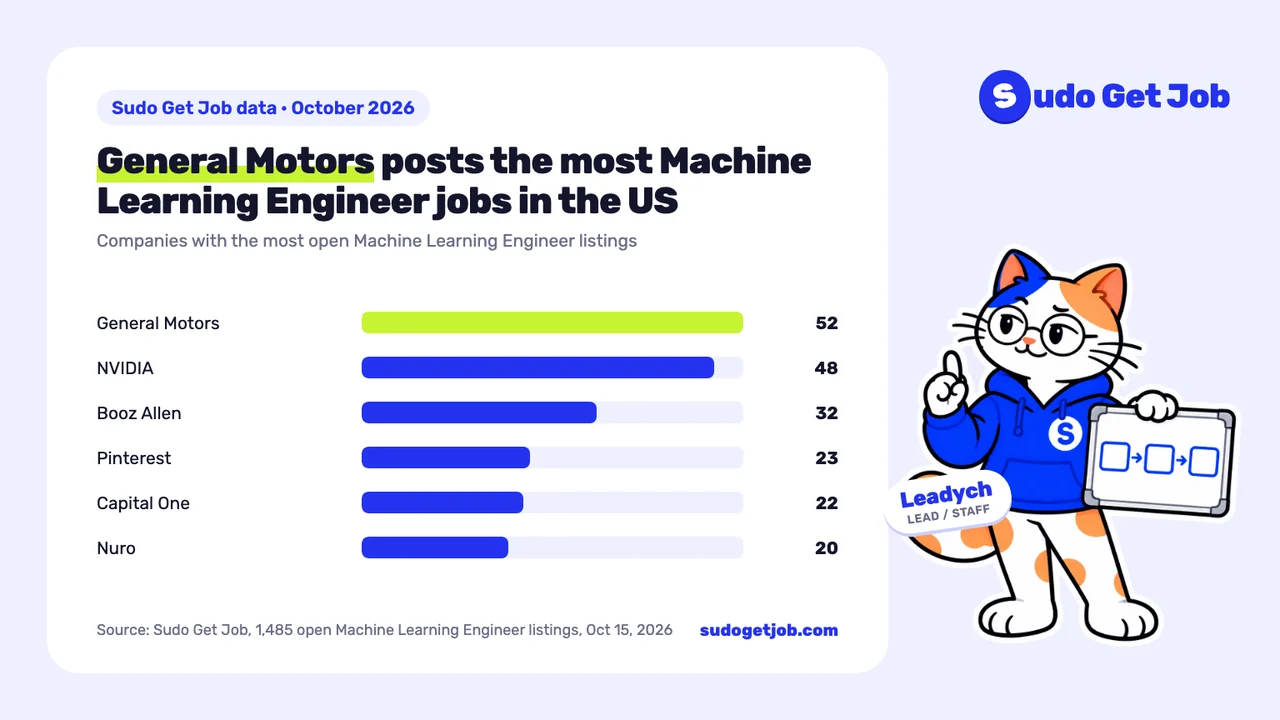
The panel above shows open Machine Learning Engineer listings right now. Use it to plan your search.
Cities
ML engineering roles cluster heavily in a few metros. The city table shows where. San Francisco leads, followed by New York and Seattle. If you can relocate, those metros give you the most interviews.
Level
The level chart shows a market weighted toward experienced engineers. Mid-level, senior and lead roles make up most openings. Entry-level roles are very rare. In October 2026 our board had about three times as many ML engineering internships as entry-level jobs. Many people move into this role after a few years as a software engineer or data scientist.
Pay
The median and the middle 50% come from salary ranges that employers posted. The Machine Learning Engineer salary page breaks them down by level and city.
Skills employers screen for
Postings list many tools. Hiring decisions rest on a shorter list.
Python and software engineering
Python appeared in about three out of four ML Engineer listings on our board in October 2026. It is the default language for training and evaluation code.
C++
C++ appeared in about one in four. It matters for inference speed, robotics, autonomous vehicles and on-device models.
Deep learning frameworks
| Framework | How often it appeared |
|---|---|
| PyTorch | In about half of our ML Engineer listings |
| TensorFlow | In fewer than a third |
If you learn one framework deeply, choose PyTorch. Know how to:
- Write a training loop
- Debug a model that does not learn
- Profile one that runs too slowly
Machine learning fundamentals
You need to know how models learn, not only how to call them. Expect questions on loss functions, optimization, regularization, overfitting, evaluation metrics and data leakage.
Large language models
Close to half of our ML Engineer listings in October 2026 mentioned LLMs. The work ranges from fine-tuning and evaluating models to building retrieval-augmented generation systems and serving models efficiently.
Production and MLOps
This is where ML engineers differ from data scientists. MLOps appeared in nearly a quarter of our listings. Kubernetes, Docker, CI/CD and cloud platforms like AWS and GCP appear often.
Learn how to:
- Package a model
- Deploy it behind an API
- Version models and data
- Roll back a bad release
- Monitor for drift
Know what happens when traffic spikes or a feature stops arriving.
Performance and hardware
Some roles focus on making models run faster. CUDA and distributed systems appear in a meaningful share of postings. These roles ask about GPU memory, batching, quantization and distributed training.
Specializations
Many roles name a domain.
Computer vision
Computer vision appeared in about one in five of our listings.
Reinforcement learning and NLP
Reinforcement learning and NLP follow.
Recommendation, ranking and search
Recommendation, ranking and search systems are common at consumer companies.
Build proof that you can ship models
ML hiring managers want evidence that a model left the notebook.
- 1
Build one project end to end
Train a model, evaluate it honestly, wrap it in an API, deploy it and add basic monitoring. A modest model in a working system is more convincing than a high score in a notebook.
- 2
Show the engineering
Include tests, a clear repository structure, a Dockerfile and a short note on how to run it. These details are what ML engineering interviews probe.
- 3
Write up your decisions
State the problem, the data, the baseline, what you tried, what failed, and the cost and latency of the final model. Put the write-up in the README or on a personal page.
- 4
Reproduce a paper
Implementing a known paper from scratch and comparing your results with the original shows depth. Explain any gaps you found.
- 5
Contribute to open source
Many ML tools are open source. A merged pull request in a training, serving or evaluation library shows you can work in a real codebase.
Write an ML engineer resume
- Lead with production impact Each bullet should say what shipped and what changed: latency cut, cost reduced, accuracy improved in production, a system that now serves real traffic. "Trained a model" is weaker than "Deployed a ranking model serving all search traffic".
- Name the stack Recruiters search for terms like "PyTorch", "Kubernetes", "MLOps", "LLMs" or "CUDA". Use the exact words from the posting where they are true for you.
- Show scale Mention data size, requests per second, number of GPUs or model size where you can.
- Keep it plain One column, standard headings, no graphics. Put GitHub and any papers at the top.
- State your degree clearly Close to 40% of our ML Engineer listings mention a PhD. Read whether it is required or preferred. Research-heavy roles ask for it more often than infrastructure roles.
Where to apply
Apply on the employer's site, and early
Every job here links to the employer's own application page. Sort by newest and filter for jobs posted in the last 7 days. Our report on how old open tech job posts are shows why freshness matters.
Use referrals
ML teams are often small. A referral from someone on the team carries weight. Ask about the team's work before you ask for the referral.
Look beyond AI labs
Banks, insurers, retailers, logistics companies, healthcare companies and defense contractors all run ML in production. Competition there is often lower than at well-known AI companies.
Move internally if you can
If you already work as a software engineer at a company with an ML team, ask to take on ML work. Internal moves are a common path into this role.
How the interview process works
ML engineering loops combine software engineering and machine learning rounds.
Recruiter screen
Background, motivation, location and pay. Have a short summary ready of your strongest ML project and the domain you want.
Coding screen
Usually a live coding session, similar to a software engineer screen. Practice problems by pattern: hashing, trees, graphs, two pointers, dynamic programming.
Machine learning fundamentals
Questions on how models learn and how to evaluate them. Common prompts:
- "Your model's offline metric improved but the online metric did not. Why?"
- "How would you handle a heavily imbalanced dataset?"
- "Explain how attention works and why it is expensive for long inputs."
ML system design
The core of most loops for mid-level roles and above. You design a full system: a recommendation feed, a fraud detector, a search ranker or an LLM-powered feature.
Use a fixed structure:
- 1
Goal and metric
- 2
Data and labels
- 3
Features
- 4
Model choice
- 5
Training pipeline
- 6
Serving
- 7
Monitoring and iteration
Discuss trade-offs out loud.
Behavioral round
Stories about a model that failed in production, a disagreement about approach, or a project with unclear requirements. Prepare a handful of stories and be specific about your own part.
Salary and negotiation
Use posted ranges
Several US states, including California, Colorado, Washington and New York, require pay ranges in job postings. Many ML listings on our board include one. The range is base pay only. Equity can be a large part of total pay at AI companies.
Set your target by level and city
Use the Machine Learning Engineer salary page to see medians by level and metro. Check the remote ML salary data if you are looking remotely.
Negotiate the whole offer
Ask how equity is valued, how it vests and what level you are offered. Level sets your scope and your next raise.
Entry-level and career-switch paths
Direct entry-level ML engineering jobs are rare. The usual routes are:
- 1
From software, backend or data engineering
Start as a software engineer, backend developer or data engineer and move toward ML work.
- 2
From data science
Start as a data scientist and add production engineering skills.
- 3
From AI engineering
Join an AI engineer team building LLM features and go deeper into training and evaluation.
- 4
Through an internship
Apply to internships during a degree, especially a research master's or PhD.
Finding a remote role
Remote ML engineering jobs exist, but competition for them is wide. See all remote Machine Learning Engineer jobs.
Our report on where remote tech jobs are shows how ML compares with other roles.
- Read the location rules in every remote posting. Some are limited to certain states. Roles that work with sensitive data or special hardware are more often on-site.
- In remote interviews, show clear written communication: design documents, experiment logs and short updates on what worked and what did not.
A short checklist
- Choose your focus: ML infrastructure, applied modeling, LLMs or a domain like vision or ranking.
- Choose your target level honestly.
- Set a salary range from the median for your level and city.
- Build one project end to end, from training to a deployed, monitored API.
- Rewrite your resume around production impact, stack and scale.
- Apply early on employers' own sites, and ask for referrals.
- Practice coding problems by pattern.
- Practice ML system design with a fixed structure.
- Prepare behavioral stories about failures in production.
- Negotiate the full offer, including equity, in writing.
Start with the current Machine Learning Engineer jobs, newest first.