What the job is
An AI engineer builds product features on top of AI models. Most of the work today uses large language models (LLMs) through an API or an open model hosted by the company.
A typical week
A typical week includes:
- Writing prompts and system instructions
- Building retrieval over company documents
- Wiring the model to internal tools
- Writing evaluations
- Tracking cost and latency
Much of the job is ordinary software engineering: APIs, databases, tests, deployments and monitoring.
The roles it overlaps with
The role overlaps with two others.
Machine learning engineer
A machine learning engineer usually trains, tunes and serves models.
Data scientist
A data scientist usually analyzes data and builds statistical models.
AI engineer
An AI engineer usually starts from an existing model and builds a product around it.
Many postings mix these duties, so read the responsibilities, not just the title.
Job titles to search
Titles vary. Search for all of these:
- AI Engineer and Applied AI Engineer
- LLM Engineer and Generative AI Engineer
- Software Engineer, AI or Software Engineer, Agents
- Member of Technical Staff, common at AI labs and some startups
- AI Solutions Engineer or Forward Deployed Engineer, for roles that build with customers
The AI Engineer market now
Work format
- On-site 56%
- Hybrid 27%
- Remote 17%
Openings by level
Where the jobs are








Read the market before you apply
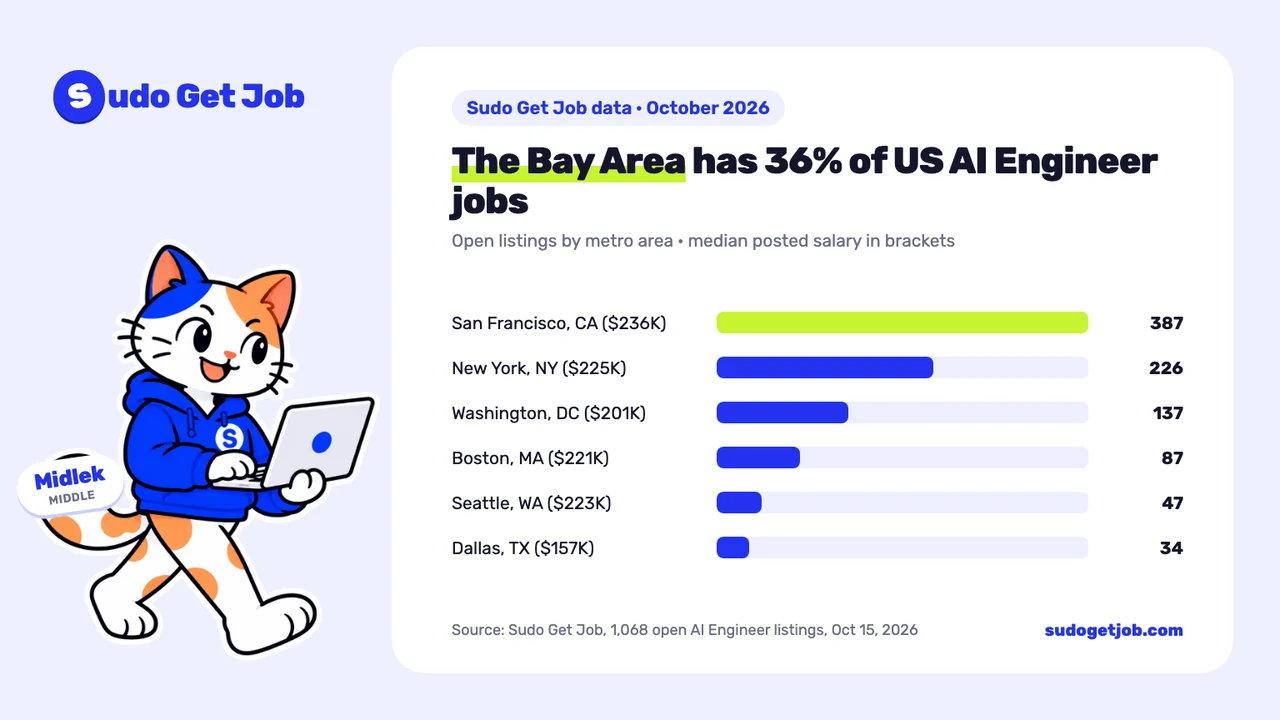
The panel above shows open AI Engineer listings right now. Use it to plan your search.
Where to look
The city table shows where roles cluster. In our listings, the San Francisco Bay Area has the largest group by a wide margin. New York comes next. The Washington DC region and Boston also have many openings. If you cannot relocate, check the remote share and the hybrid roles nearby.
Which level to target
The level chart shows the mix. Senior and lead roles make up a large share of AI engineering openings. Entry-level and intern roles are few. Many employers want AI engineers who already have a few years of software engineering behind them.
What pay to expect
The median and the middle 50% come from salary ranges that employers posted. The AI Engineer salary page breaks them down by level and city.
Skills employers list most often
We tag the skills named in each job description. For AI engineer roles in our listings:
| How often | Skills |
|---|---|
| The most common | LLMs, Python, machine learning, AI agents and generative AI |
| Come next | RAG, AWS, CI/CD, Azure and GCP |
| Also appear often | Prompt engineering, PyTorch, LangChain, vector databases and the OpenAI API |
Python and solid software engineering
Python is the main language of the field. You need to write clean, tested Python that runs in production, not just in a notebook.
The engineering basics matter as much as the AI skills. Learn API design, async code, queues, caching, databases and logging.
Working with LLMs
This is the core of the job. Learn how LLMs behave in practice:
- How context windows, tokens and temperature affect output, cost and speed
- How to write clear instructions and give examples in a prompt
- How to get structured output, such as JSON that matches a schema
- How tool calling works, so the model can query a system or take an action
- Where models fail: invented facts, ignored instructions, inconsistent formatting
Retrieval and RAG
Retrieval-augmented generation (RAG) means finding relevant documents and giving them to the model with the question. It is one of the most common patterns in AI products.
Learn how to:
- 1
Split documents into chunks
- 2
Create embeddings
- 3
Store them in a vector database
- 4
Combine vector search with keyword search
Learn how to measure retrieval quality on its own, separate from the final answer.
Agents
AI agents are systems where the model plans steps and calls tools in a loop. They appear in a large share of our AI engineer listings.
Learn:
- How to design tools with clear inputs and outputs
- How to limit what an agent can do
- How to stop it when it goes wrong
Evaluation
Evaluation is what separates a demo from a product. Learn to build a test set of real inputs, define what a good answer looks like and score outputs automatically where you can.
Know the common methods:
Exact checks
Rules
Human review
Using a model as a grader
Be able to explain how you would catch a quality drop before users do.
Cloud and deployment
AWS is the cloud named most often, followed by Azure and GCP. Each cloud also offers hosted model services. Learn how to deploy a service, manage secrets and API keys, monitor latency and cost and roll back a bad release. CI/CD and Docker are expected.
Machine learning background
Machine learning appears in many AI engineer listings, and PyTorch in some.
Most product-focused roles
For most product-focused roles you need the concepts, not research depth: training versus inference, embeddings, overfitting, fine-tuning and how to read a model card.
Roles that fine-tune or host models
For roles that fine-tune or host open models, expect deeper questions.
Build proof of skill
Many candidates have built a chatbot demo. Hiring managers want to see more than that.
- 1
Build one project that solves a real task
Pick a narrow problem with real documents or real users. For example, answering questions over a public set of manuals or sorting support tickets into categories.
- 2
Measure it
Build a small evaluation set and report the results. Show how a change to retrieval or the prompt moved the score. This is the single most convincing thing you can put in an AI portfolio.
- 3
Show the engineering
Handle errors and timeouts. Log every model call. Track cost per request. Add tests. Deploy it to a public URL.
- 4
Write about what failed
A short write-up that explains a failure case and how you fixed it shows judgment. Interviewers ask about this directly.
- 5
Contribute to open source
Many AI tools and frameworks are open source. A merged fix or documentation improvement in one of them shows you can work in a real codebase.
Write a resume for AI engineer roles
Lead with shipped AI features
Say what the feature did, who used it and what changed. Usage, time saved, tickets resolved, accuracy on an evaluation set.
Name the methods
RAG, tool calling, evaluation, fine-tuning, agents. Use the exact terms from the posting where they are true for you.
Show the engineering around the model
Latency, cost, monitoring and reliability work is valuable. Many candidates leave it out.
Be honest about depth
Do not list model training if you only called an API. Interviewers will ask, and a clear, honest scope reads better than an inflated one.
Keep the format plain
One column, standard headings, no graphics. Put GitHub and a link to your best project at the top.
Where to apply
- Apply on the employer's site, and early Every job here links to the employer's own application page. Sort by newest and filter for jobs posted in the last 7 days. Our report on how old open tech job posts are shows why freshness matters.
- Look beyond AI labs Banks, insurers, healthcare companies, retailers and software firms of every size are hiring people to build AI features. Competition there is often lower than at well-known AI companies.
- Use your domain AI products need people who understand the work being automated. A former lawyer, nurse or accountant who can build AI systems is valuable to companies in that field.
- Ask for referrals Reach out to engineers you know at target companies. Ask about the team's AI work before you ask for a referral.
How the interview process works
AI engineer loops are still settling into a standard shape. Most include these stages.
Recruiter screen
Background, motivation, location and pay. Be ready to describe one AI project in two minutes: the problem, the approach and the result.
Technical screen
Often a coding round in Python. Some companies use standard algorithm problems. Others ask you to build something small with a model API, such as a function that extracts structured data from text and handles bad output.
Take-home project
Some companies send a take-home task: build a small RAG system or agent and report how well it works.
Final loop
A typical loop includes:
Coding
A coding round, often practical
AI system design
An AI system design round: design a support assistant, a document search tool or an agent for an internal workflow
Past projects
A discussion of your past projects in depth
Behavioral
A behavioral round about ownership, mistakes and working with product and data teams
For AI system design, use a fixed structure:
- 1
The user and task
- 2
Data sources
- 3
Retrieval
- 4
Model choice
- 5
Tools
- 6
Evaluation
- 7
Safety limits
- 8
Cost and latency
- 9
Then monitoring
Interviewers want to hear how you would know the system works and what you would do when it does not.
Salary and negotiation
Use posted ranges
Several US states, including California, Colorado, Washington and New York, require pay ranges in job postings. Many AI engineer listings on our board include one. The range is base pay only.
Set your target by level and city
Use the AI Engineer salary page for medians by level and metro. Check the remote salary data if you are searching remotely.
Ask how the company levels the role
AI engineer titles are new, and companies map them to levels differently. Ask which engineering level the offer sits at. Level sets your scope and your next raise.
Negotiate the whole offer
Bonus, equity, signing bonus and title all matter. At startups, ask about the equity terms in writing.
Breaking in
Entry-level AI engineer roles are rare. The level chart above shows how rare. These paths are more common:
From software engineering
Get a software engineer, full stack or backend developer role and volunteer for the team's AI features.
From data work
Move from data engineering or data science, where you already work with the data AI systems need.
At a startup
Join a startup where everyone builds AI features.
Through internships
Apply to AI-focused internships and new-grad programs.
Finding a remote role
Remote AI engineering jobs exist, but many AI teams prefer hybrid work in a few cities. See all remote AI Engineer jobs.
Our report on where remote tech jobs are shows how this role compares with others.
- Read the location section of every remote posting. Many are limited to certain states or time zones.
- In interviews, show clear written communication: design notes, evaluation reports and updates that others can read without a meeting.
A short checklist
- Decide whether you want product AI work or model-focused work.
- Get solid at Python and production software basics.
- Learn LLM APIs, RAG, tool calling and evaluation.
- Build one real project, measure it and deploy it.
- Set a salary range from the median for your level and city.
- Rewrite your resume around shipped features and measured results.
- Apply early on employers' own sites, inside and outside tech.
- Practice AI system design with a fixed structure.
- Prepare stories about failures you found and fixed.
- Ask about leveling, then negotiate the full offer in writing.
Start with the current AI Engineer jobs, newest first.