
What the job is
A QA engineer makes sure software works before users find out it does not.
The job covers:
- 1
Planning what to test
- 2
Testing by hand where it makes sense
- 3
Writing automated tests
- 4
Running them in a pipeline
- 5
Reporting defects clearly enough that developers can fix them
Manual and automated testing
The job has moved toward automation.
Automation
Many teams expect QA engineers to write test code in the same repository as the product.
Manual testing
Manual testing still matters for new features, usability and edge cases that are hard to script.
Most roles today ask for both.
Job titles to search
Titles vary. Search for all of these:
- QA Engineer and Quality Assurance Engineer
- Software Development Engineer in Test (SDET), common at large tech companies
- Test Automation Engineer and Automation Engineer
- Software Quality Engineer and Software Test Engineer
- QA Analyst and QA Tester, often more manual and closer to entry level
The QA Engineer market now
Work format
- On-site 70%
- Hybrid 17%
- Remote 13%
Openings by level
Where the jobs are



Read the market before you apply
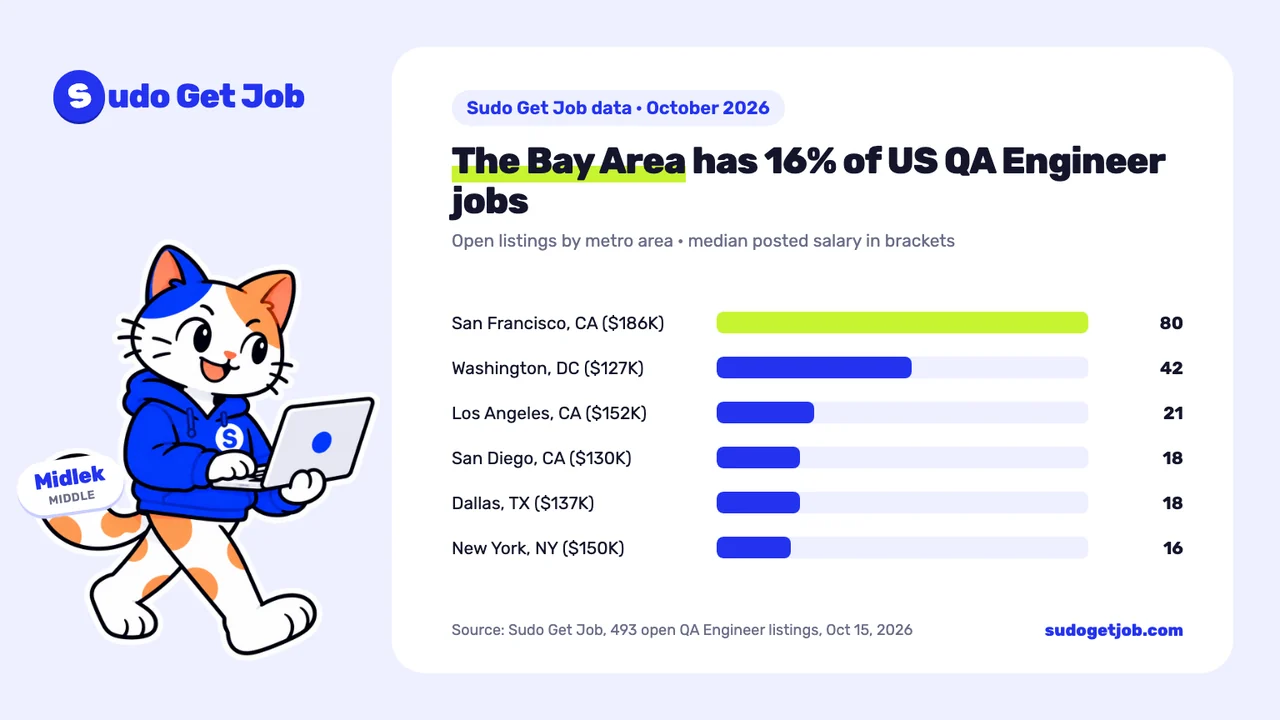
The panel above shows open QA Engineer listings right now. Use it to plan your search.
Where to look
The city table shows where roles cluster. In our listings, the San Francisco Bay Area has the largest group. Texas, Virginia and the Washington DC region follow. Portland, Oregon also has a noticeable cluster. If you cannot relocate, check the remote share and hybrid roles nearby.
Which level to target
The level chart shows the mix. Mid-level roles make up most of the market. QA has more entry-level and intern openings than many other engineering roles on our board. That makes it a realistic first job in tech.
What pay to expect
The median and the middle 50% come from salary ranges that employers posted. The QA Engineer salary page breaks them down by level and city.
Skills employers list most often
We tag the skills named in each job description. For QA roles in our listings:
| How often | Skills |
|---|---|
| The most common | Test automation, Python, CI/CD, Agile and Jira |
| Come next | Java, Selenium, Git, SQL and Jenkins |
| Also appear often | Load testing and Playwright |
Testing fundamentals
Tools change. The thinking behind testing does not. Learn how to:
- Read a requirement and turn it into test cases
- Choose test inputs: valid, invalid, boundary values, empty and very large
- Decide what to test by hand and what to automate
- Write a defect report with steps to reproduce, expected result, actual result and evidence
- Judge risk: which bugs block a release and which can wait
Test automation
Test automation is the skill named most often in our QA listings. Learn one language well. Python is the most common in our data, followed by Java. JavaScript and TypeScript are common for web teams.
Then learn the main layers of automated tests:
Unit tests
Usually written by developers, which you should be able to read and review
API tests
Check endpoints directly and run fast
UI tests
Drive a real browser or app and are slower and more fragile
For browser testing, Selenium is the tool named most often in our QA listings. Playwright appears close behind and is common on newer teams. Learn one well. Know how to find elements reliably, wait for the page correctly and keep tests independent of each other.
APIs and databases
Much of modern testing happens below the interface. Learn how REST APIs work: methods, status codes, headers, JSON bodies and authentication. Learn enough SQL to set up test data and check what the application stored.
CI/CD
Automated tests are only useful if they run on every change. Learn how tests run in a CI/CD pipeline. Jenkins is the CI tool named most often in our QA listings. Know how to run tests in parallel, collect reports and decide which failures should block a merge.
Performance testing
Load testing appears in a share of our QA listings. Learn the basic idea: simulate many users, measure response time and error rate, and find the point where the system slows down.
Process and tools
Agile and Jira appear in many listings. QA engineers usually join sprint planning, estimate testing work and track defects in a ticket system. Learn how a ticket moves through a workflow and how to write one that a developer can act on without a follow-up question.
Build proof of skill
QA work is easy to show if you make it public.
- 1
Build a test suite for a real application
Pick an open-source web app or a public demo site made for testing practice. Write UI tests for the key flows, API tests for the main endpoints and a short test plan. Run them in a free CI service on every push.
- 2
Show the reports
Include a test report and a screenshot or recording of a failure. Show how a developer would find the cause.
- 3
Write sample bug reports
Find real bugs in an open-source project and report them on its issue tracker. Clear, reproducible reports that maintainers act on are strong evidence.
- 4
Contribute tests to open source
Many projects welcome new tests. A merged pull request shows you can work in someone else's codebase.
- 5
Write a README
Explain what you tested, what you did not test and why. This shows judgment about risk, which is the core of QA.
Write a resume for QA roles
Lead with your automation stack
A short skills line near the top: language, test framework, API testing tool, CI tool. Recruiters scan for these words.
Show results
Test coverage you added, regression time reduced, release defects reduced, flaky tests fixed. If you have no number, describe the effect plainly.
Show what you automated
For example: replaced a two-day manual regression with an automated suite that ran on every merge. That tells a hiring manager more than "performed testing".
Show the kind of product
Web, mobile, API, embedded or data. QA roles differ a lot by product type. Name yours.
Keep the format plain
One column, standard headings, no graphics. Link your test project at the top.
Where to apply
Apply on the employer's site, and early
Every job here links to the employer's own application page. Sort by newest and filter for jobs posted in the last 7 days. Our report on how old open tech job posts are shows why freshness matters.
Look at regulated industries
Healthcare, finance, government and automotive companies often have formal testing processes and steady demand for QA engineers.
Look at hardware and embedded teams
Some QA listings test devices, robots or embedded systems. If you know electronics, these roles have less competition from pure web testers.
Ask for referrals
Reach out to people you know at target companies. Ask what their QA team looks like before you ask for a referral.
How the interview process works
QA loops usually include these stages.
Recruiter screen
Background, the kind of testing you have done, location and pay. Be ready to say how much of your work was manual and how much was automated.
Technical screen
Often a mix of testing questions and coding. You might be asked how you would test a feature, then asked to write a small function or a test for it. SDET roles often include standard coding problems like software engineer interviews.
Practical round
Many QA loops include a hands-on task. You might write automated tests for a web page or an API, review a buggy test suite or find as many defects as you can in a small app.
Final loop
A typical loop includes:
A test design round
"How would you test this?" for a product or feature
An automation round
Write or review test code
A framework design round for senior roles
How you would structure a test suite for a whole product
A behavioral round
About disagreements with developers, missed bugs and release decisions
Salary and negotiation
Use posted ranges
Several US states, including California, Colorado, Washington and New York, require pay ranges in job postings. Many QA listings on our board include one. The range is base pay only.
Set your target by level and city
Use the QA Engineer salary page for medians by level and metro. Check the remote salary data if you are searching remotely.
Know your title
SDET and automation roles are often leveled closer to software engineering roles than manual QA roles are. If your work is mostly automation, look for those titles and set your range accordingly.
Negotiate the whole offer
Bonus, equity, signing bonus, title and remote days all matter. Ask in writing and stay polite.
Breaking in at entry level
QA is one of the more open doors into tech. Entry-level paths include:
Internships and junior roles
Apply to QA internships and junior QA analyst roles.
Manual first
Start as a manual tester and learn automation on the job.
From customer support
Move from customer support, where you already find and describe bugs.
Domain knowledge
Use domain knowledge: a former pharmacist can test healthcare software, a former bank teller can test banking apps.
Finding a remote role
Remote QA jobs exist, but they are a smaller share of QA openings than for some other roles. Hardware and device testing usually needs on-site work. See all remote QA Engineer jobs. Our report on where remote tech jobs are shows how this role compares with others.
- Read the location section of every remote posting. Many remote roles are limited to certain states or time zones.
- In interviews, show that your bug reports and test plans are clear enough to work without a meeting.
A short checklist
- Decide whether you want web, mobile, API or hardware testing.
- Learn testing fundamentals and practice "How would you test this?" out loud.
- Learn one language and one browser automation tool well.
- Build a public test suite that runs in CI.
- Set a salary range from the median for your level and city.
- Rewrite your resume around automation and results.
- Check that each posting is a software QA role before you apply.
- Apply early on employers' own sites and ask for referrals.
- Prepare a story about a missed bug and what you changed.
- Negotiate every offer in writing.
Start with the current QA Engineer jobs, newest first.