
What the job is
A DevOps engineer builds and runs the systems that take code from a developer's laptop to production and keep it running there. That includes build and deploy pipelines, cloud infrastructure, containers, monitoring and the response when something breaks.
Most of the work is automation
Most of the work is automation. A DevOps engineer writes code that:
- Creates servers
- Configures networks
- Deploys services
- Checks their health
Clicking through a cloud console by hand is the thing the job is meant to remove. Expect to read and write a lot of configuration files, scripts and pipeline definitions.
The roles around it
The role overlaps with several others.
Site reliability engineer
A site reliability engineer focuses more on reliability targets and incident response for large systems.
Cloud engineer
A cloud engineer focuses on designing and running cloud accounts and services.
Systems administrator
A systems administrator manages servers and internal IT systems.
Many postings mix these duties, so read the responsibilities, not just the title.
Job titles to search
Titles vary. Search for all of these:
- DevOps Engineer
- Platform Engineer, for teams that build internal tools and paved paths for developers
- Infrastructure Engineer
- Build and Release Engineer
- DevSecOps Engineer, when security is a large part of the role
The DevOps Engineer market now
Work format
- On-site 67%
- Hybrid 19%
- Remote 14%
Openings by level
Where the jobs are



Read the market before you apply
The panel above shows open DevOps Engineer listings right now. Use it to plan your search.
Where to look
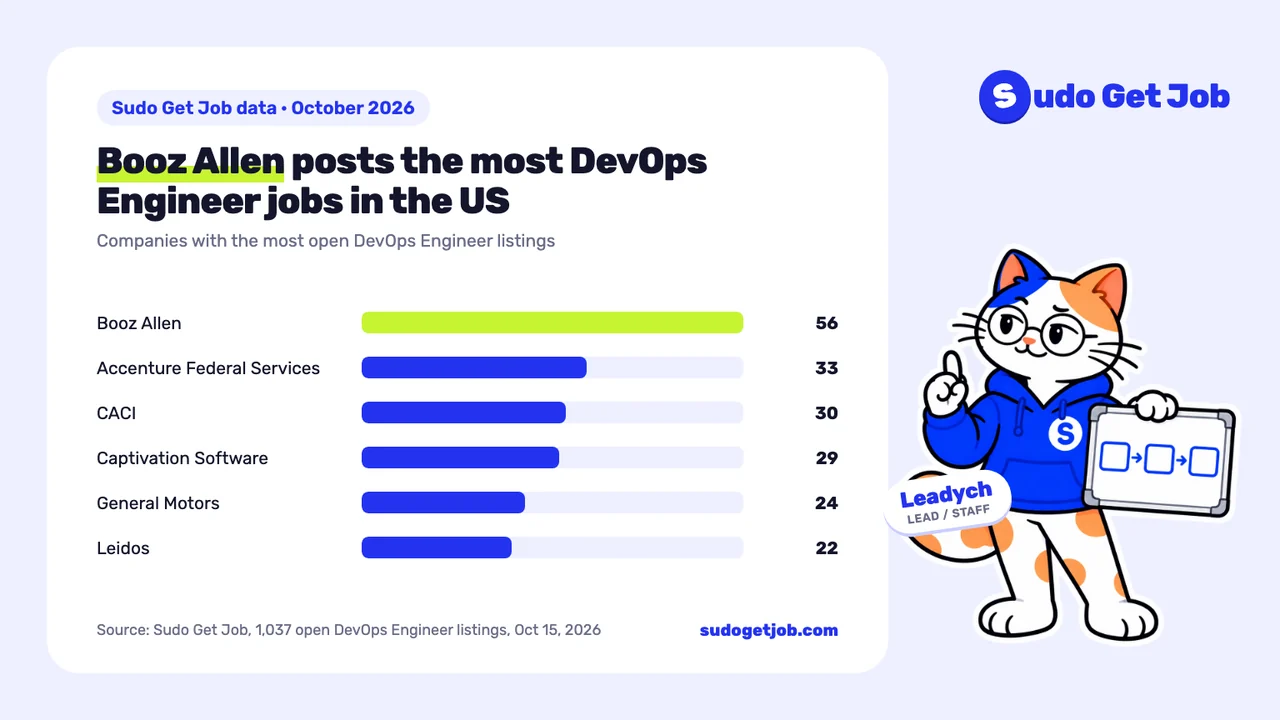
The city table shows where roles cluster. In our listings, the San Francisco Bay Area and the Washington DC region have the largest groups. Virginia, Maryland and Texas also have many openings. Many of the DC-area roles come from government contractors.
Which level to target
The level chart shows the mix. Mid-level and senior roles make up most of the market. Entry-level DevOps roles are rare. Many people move into DevOps from another technical role.
What pay to expect
The median and the middle 50% come from salary ranges that employers posted. The DevOps Engineer salary page breaks them down by level and city.
Skills employers list most often
We tag the skills named in each job description. For DevOps roles in our listings:
| How often | Skills |
|---|---|
| The most common | CI/CD, Kubernetes, AWS, Python and Terraform |
| Come next | Docker, Linux, Azure, Bash and Ansible |
Linux and networking
Linux is the base layer of almost everything you will run. Learn the command line, processes, permissions, systemd services, logs and package management.
Learn enough networking to debug a connection:
IP addresses and subnets
DNS and ports
TLS certificates
Load balancers and firewalls
Scripting
Bash
Learn Bash for small glue scripts.
Python
Learn Python for anything larger.
Go
Go appears in some listings, mostly for teams that write their own tools or Kubernetes operators.
You do not need to be a software engineer. You need to write clear, tested scripts that other people can run safely.
CI/CD pipelines
CI/CD is the skill named most often in our DevOps listings.
Learn how to build a pipeline that:
- 1
Runs tests
- 2
Builds an artifact
- 3
Scans it
- 4
Deploys it
The tools vary by company: GitLab CI, Jenkins and GitHub Actions are the most common in our data. Learn one well and understand the shared ideas: stages, runners, secrets, caching and approvals.
Containers and Kubernetes
- 1
Learn Docker first
Learn Docker first: images, layers, registries, environment variables and how to keep images small and secure.
- 2
Then learn Kubernetes
Then learn Kubernetes, which appears in most of our DevOps listings. Know deployments, services, ingress, config maps, secrets, resource limits and how to debug a pod that keeps restarting.
Cloud
AWS is the cloud named most often in our DevOps listings, followed by Azure and GCP. Learn one deeply. Know compute, storage, networking (VPCs, subnets, security groups), identity and access management (IAM) and cost basics.
Infrastructure as code
Terraform
Terraform is the infrastructure-as-code tool named most often in our data. Learn modules, state, plans and how to review an infrastructure change safely.
Ansible
Ansible is common for configuring servers.
Be ready to explain how you would stop two people from changing the same infrastructure at the same time.
Monitoring and incidents
Systems fail. Employers want to know you can see it and respond. Learn metrics, logs and alerts.
- Prometheus and Grafana are the monitoring tools named most often in our DevOps listings.
- Learn how to write an alert that is useful rather than noisy.
- Learn how to run an incident and write a blameless summary afterward.
Security basics
DevOps engineers handle secrets, access and the software supply chain. Learn least-privilege access, secret storage, image scanning and patching.
Build proof of skill
DevOps work is hard to show in a portfolio because it runs inside companies. A small, well-documented lab fixes that.
- 1
Build a home lab in the cloud
Use Terraform to create a network and a small Kubernetes cluster. Deploy a simple app with a CI/CD pipeline. Add monitoring and one useful alert. Tear it down and recreate it from code to prove it works.
- 2
Write it up
Put the code in a public repository with a README that explains the design, the choices you made and how to run it. Include a diagram. Keep cloud costs low and say how.
- 3
Break it on purpose
Kill a pod, fill a disk, expire a certificate. Write down what the monitoring showed and how you fixed it. Interviewers often ask for stories like these.
- 4
Get a certification if it fits your target
Some employers, especially government contractors, list cloud or Kubernetes certifications in their requirements. A certification does not replace hands-on proof, but it can get you past a screen.
Write a resume for DevOps roles
Lead with your core stack
A short skills line near the top: cloud, container platform, CI/CD tool, infrastructure-as-code tool, languages. Recruiters scan for these words.
Show scale and results
Number of services, environments or developers you supported. Deploy time before and after. Incidents reduced. Cloud cost saved. If you have no number, describe the effect plainly.
Show automation
Good bullets describe a manual process you replaced with code. For example: replaced manual server setup with Terraform and Ansible, so new environments took minutes instead of days.
Include clearance and certifications
If you have them, put them near the top. For government roles, they decide whether a recruiter reads further.
Keep the format plain
One column, standard headings, no graphics. Link your lab repository at the top.
Where to apply
Apply on the employer's site, and early
Every job here links to the employer's own application page. Sort by newest and filter for jobs posted in the last 7 days. Our report on how old open tech job posts are shows why freshness matters.
Consider government contractors
They hire many DevOps engineers, especially around Washington DC, Virginia and Maryland. Eligibility rules are strict, but competition from other applicants can be lower.
Look beyond tech companies
Banks, healthcare systems, retailers and manufacturers all run cloud infrastructure and need people to automate it.
Ask for referrals
Reach out to engineers you know at target companies. Ask about their stack before you ask for a referral.
How the interview process works
DevOps loops differ between companies. Most include these stages.
- 1
Recruiter screen
Background, stack, location, pay and, for government roles, clearance and citizenship. Have a short summary of the systems you have run.
- 2
Technical screen
Often a conversation with an engineer about your experience, with follow-up questions that go deep. "How does your pipeline deploy to production?" "What happens if the deploy fails halfway?" Some companies add a scripting task in Bash or Python.
- 3
Hands-on or troubleshooting round
Many DevOps loops include a practical task. You might fix a broken Dockerfile, debug a failing Kubernetes deployment, write Terraform for a small setup or troubleshoot a slow server. Talk through what you check and why. A clear method matters more than speed.
- 4
System design round
Design the infrastructure for a service: networking, compute, data storage, deploys, monitoring, backups and failover. Be ready to discuss trade-offs between managed services and running things yourself.
- 5
Behavioral round
Stories about incidents, mistakes, on-call, disagreements with developers and automation you introduced. Prepare a few. Be honest about your part and what you changed afterward.
Salary and negotiation
Use posted ranges
Several US states, including California, Colorado, Washington and New York, require pay ranges in job postings. Many DevOps listings on our board include one. The range is base pay only.
Set your target by level and city
Use the DevOps Engineer salary page for medians by level and metro. Check the remote salary data if you are searching remotely.
Ask about on-call
On-call duty is common in DevOps roles. Ask how often you would be on call, whether it is paid and how many alerts the team gets. It affects your real workload.
Negotiate the whole offer
Bonus, equity, signing bonus, title and remote days all matter. Ask in writing and stay polite.
Breaking in
Entry-level DevOps roles are rare. The level chart above shows how rare. These paths are more common:
From systems administration or IT support
Start as a systems administrator or IT support specialist and take on automation work.
From software engineering
Start as a software engineer and own your team's pipeline and deploys.
From QA engineering
Start in QA engineering, where test pipelines lead naturally to CI/CD work.
From network engineering
Start as a network engineer and move toward cloud networking.
Finding a remote role
Remote DevOps jobs exist, but government roles are often on-site or hybrid. See all remote DevOps Engineer jobs.
Our report on where remote tech jobs are shows how this role compares with others.
- Read the location section of every remote posting. Many remote roles are limited to certain states or time zones because of on-call coverage.
- In interviews, show that you write clear runbooks, incident summaries and change notes.
A short checklist
- Get comfortable with Linux, networking and one scripting language.
- Learn one cloud, Docker, Kubernetes and Terraform hands-on.
- Build a cloud lab from code, with a pipeline and monitoring.
- Check clearance and citizenship requirements before you apply.
- Set a salary range from the median for your level and city.
- Rewrite your resume around automation, scale and results.
- Apply early on employers' own sites and ask for referrals.
- Practice troubleshooting out loud with a clear method.
- Prepare incident stories and what you changed afterward.
- Ask about on-call, then negotiate the full offer in writing.
Start with the current DevOps Engineer jobs, newest first.