
What the job is
A cybersecurity analyst protects an organization's systems and data by watching for threats, investigating them and helping fix weak spots. Most of the day is reading: alerts, logs, emails, reports and configuration. The analyst decides what is real, what is noise and what needs action now.
Branches of the role
The role has several branches. Postings use the same general title for quite different work, so read the duties closely.
Security operations (SOC)
You monitor alerts, triage them and escalate real incidents. This is the most common entry point.
Incident response
You investigate confirmed incidents, find the scope and help contain and recover.
Vulnerability management
You run scans, rank the findings and work with IT teams to patch.
Threat intelligence
You track attacker groups and techniques and turn that into detection ideas and warnings.
Governance, risk and compliance (GRC)
You map controls to frameworks, run assessments and prepare for audits.
Job titles to search
Search for all of these titles:
- Cybersecurity Analyst, Cyber Security Analyst, Security Analyst
- Information Security Analyst, Information Security Specialist
- SOC Analyst, Security Operations Engineer
- Threat Intelligence Analyst, Cyber Threat Analyst
- GRC Analyst, Information Security Risk Specialist
The Cybersecurity Analyst market now
Work format
- On-site 71%
- Hybrid 17%
- Remote 12%
Openings by level
Where the jobs are





Read the market before you apply
The panel above shows open Cybersecurity Analyst listings right now. Use it to plan your search.
Cities
The Washington, DC metro usually leads the city table for this role. Federal agencies and their contractors hire many analysts there. If you live elsewhere, check the hybrid roles in your metro and the remote share.
Employers
Defense and government contractors often fill the top of the hiring table. When we checked our listings in October 2026, more than a third of cybersecurity analyst postings mentioned a security clearance. Cleared roles usually require US citizenship. Some accept candidates who can obtain a clearance after the offer.
Level
The level chart shows the mix. Read the requirements, not just the title. Entry-level security roles are scarce, and many "analyst" postings ask for several years of IT or security work.
Pay
The median and the middle 50% come from salary ranges that employers posted. The Cybersecurity Analyst salary page breaks them down by level and city.
Skills employers screen for
Security postings are long. Most hiring decisions rest on a shorter list.
Incident response
Incident response was the skill named most often in our cybersecurity analyst listings when we checked. It appeared in close to four in ten.
You need to know the basic phases:
- 1
Detect
- 2
Analyze
- 3
Contain
- 4
Eradicate
- 5
Recover
- 6
Learn
Logs and detection tools
Analysts live in a SIEM. Splunk is the product named most often in our listings, but the skill transfers between tools.
- Learn to search logs, filter by time and host, and build a simple timeline.
- Know what an EDR tool shows on a laptop or server and how it differs from a SIEM.
Networking and operating systems
You cannot spot unusual traffic without knowing normal traffic. Learn TCP/IP, DNS, common ports and protocols, and how firewalls decide what to allow. Know Windows event logs and the basics of Linux. Many investigations end in a process list or an authentication log.
Vulnerability management
Vulnerability management appeared in about three in ten postings when we checked. Learn how a scanner works, how a finding is scored and why not every critical finding is urgent.
Identity and access
Many incidents start with a stolen account.
Learn the basics of identity and access management:
- Least privilege
- Multi-factor authentication
- Single sign-on
- How to review who has access to what
Frameworks and compliance
NIST frameworks were named in about three in ten postings when we checked. Federal and contractor roles lean on them heavily. Other common names are ISO 27001, SOC 2, HIPAA and PCI DSS.
SOC work
For SOC work you need to recognize them.
GRC work
For GRC work you need to know one or two in depth.
Cloud
Many organizations now run most systems in the cloud. AWS and Azure both appear often in security postings. Learn where cloud logs live, how cloud permissions work and what a public storage bucket looks like.
Scripting
Python appeared in about one in five postings. PowerShell is useful on Windows networks.
Writing
Analysts write incident tickets, investigation notes and reports for people who are not in security. A clear, short summary of what happened, what was affected and what to do next is a skill that hiring managers test directly.
Certifications
Certifications carry more weight in security than in most tech roles. Some government and contractor jobs require a specific certification for the position.
In our listings, the certifications named most often were CISSP, the CompTIA family, GIAC certifications and CISM. They target different levels.
- CompTIA Security+ is the usual first security certification. Many entry and contractor roles name it.
- CompTIA CySA+ and GIAC analyst certifications focus on detection and response.
- CISSP and CISM are aimed at experienced practitioners and managers. They require years of work experience to hold fully.
- OSCP is a hands-on certification for penetration testing roles.
Build proof of skill
Security hiring managers want to see that you can investigate, not only that you passed exams.
- 1
Build a home lab
Set up a few virtual machines, a free SIEM and some log sources. Generate normal traffic, then simulate an attack and try to detect it. Document each step.
- 2
Write investigation write-ups
Take a public practice scenario or a capture-the-flag challenge. Write it up like a real ticket: alert, evidence, timeline, conclusion, recommended fix. Two or three of these on GitHub or a personal page are strong proof.
- 3
Write a detection rule
Pick a known attacker technique and write a rule that would catch it in your lab. Explain what it catches, what it misses and what false positives you saw.
- 4
Use your current job
If you work in IT, volunteer for security tasks: review access, help with patching, respond to phishing reports. Ask to shadow the security team. These tasks count as security experience on a resume.
Write a resume that survives screening
Keep the format plain
One column, standard headings, a common font. Parsing software skips tables and text in images.
Put certifications and clearance near the top
Recruiters for cleared and contractor roles scan for both first. State your clearance level only as it is, and only where it is appropriate to share.
Describe investigations, not just tools
"Monitored Splunk" says little. "Triaged around 40 alerts per shift and escalated two confirmed account takeovers" says what you did and at what scale. Use numbers you actually know.
Match the posting's words
If the job asks for SIEM, EDR and NIST 800-53, use those exact terms where they are true for you.
Show lab work as experience
A "Projects" section with your lab, detection rules and write-ups is fair to include when you are new. Link to the write-ups.
Where to apply
Apply on the employer's site, and early
Every job on our board links to the employer's own application page. Sort by newest and filter for jobs posted in the last 7 days. Our report on how old open tech job posts are shows why freshness matters.
Look at the full range of employers
Banks, insurers, hospitals, universities, retailers, managed security providers and government agencies all hire analysts. Managed security providers run SOCs for many clients at once. They hire more entry analysts than most companies.
Decide on clearance work early
If you are a US citizen and can pass a background check, cleared roles open a large part of this market. Read each posting for the exact clearance and whether the employer will sponsor it.
Ask for referrals
Security is a small field in many cities. Local meetups and conference volunteer roles are good places to meet people who hire.
How the interview process works
Security interviews mix technical questions, scenarios and behavior.
Recruiter screen
Background, location, clearance status, certifications and pay. Know your salary range before the call. Ask whether the role includes shifts or on-call, which is common in SOC work.
Technical interview
Expect fundamentals questions and short scenarios. Common examples:
- What happens when you type a website address into a browser?
- What is the difference between a vulnerability, a threat and a risk?
- A user reports a suspicious email with a link. Walk me through your response.
- You see many failed logins followed by one success from a new country. What do you do?
- How would you explain this finding to a non-technical manager?
Practical exercise
Some companies give you logs or a packet capture to analyze, or a short take-home investigation. Write up your findings the way you would at work. The write-up is graded as much as the answer.
Behavioral round
Questions about pressure, mistakes, disagreement and handling sensitive information. Prepare stories using the situation, task, action, result structure. Integrity matters a lot in this field. Show that you follow process even when it is slower.
Salary and negotiation
Know what the ranges mean
Several US states, including California, Colorado, Washington and New York, require pay ranges in job postings. Federal contractors often post very wide ranges that cover several levels. The range is base pay.
Set your number from data
Use the Cybersecurity Analyst salary page to see the median and middle 50% for your level and city.
Ask about the extras that matter in security
Shift differentials, on-call pay, a training budget, paid certification exams and time to attend conferences all add real value.
Entry-level and career-switch paths
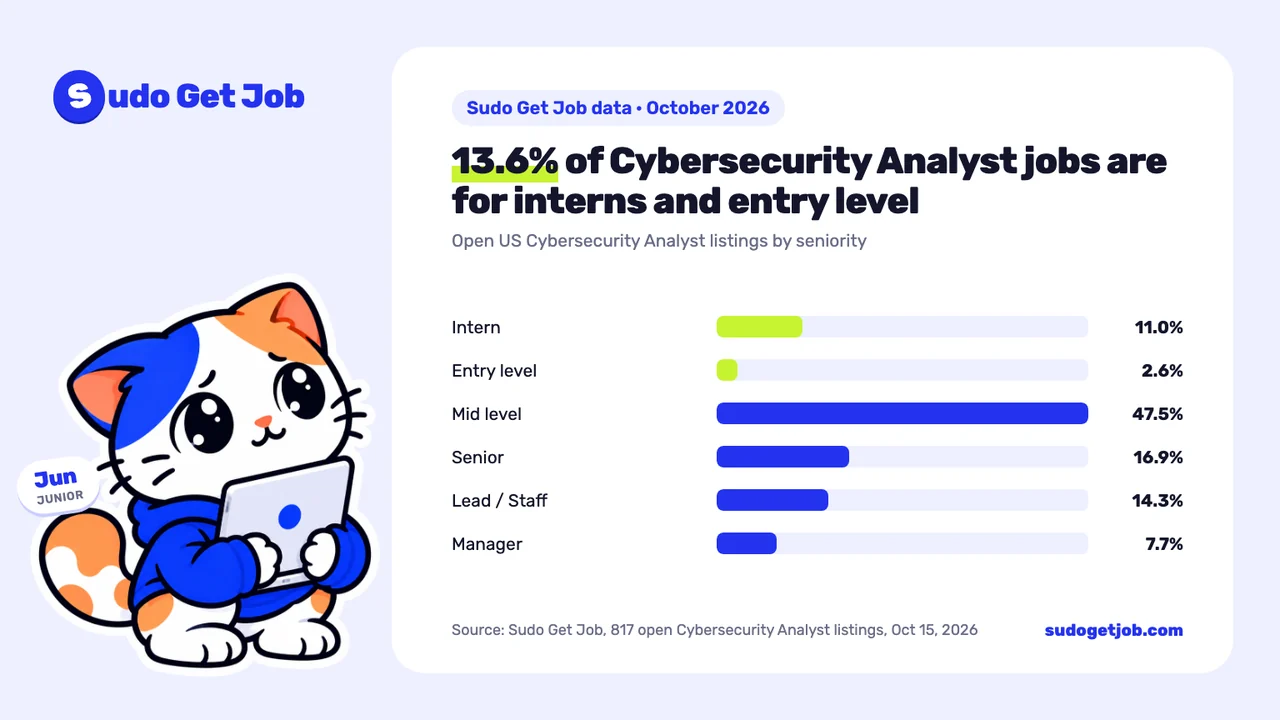
Few people get a security analyst job as their first job in tech. The common paths are:
From IT support
Start in IT support, then move into security tasks. See our IT Support Specialist guide.
From systems or network work
Work as a systems administrator or network engineer. Admins already know the systems that attackers target. See our Systems Administrator guide.
Through a managed SOC
Start in a SOC at a managed security provider, where entry roles are more common.
Through an internship
Apply to security internships, which appear in the level chart above.
Finding a remote role
Remote security analyst roles exist, mostly at private companies and security vendors. See all remote Cybersecurity Analyst jobs and the remote salary data.
- Cleared roles are rarely remote because classified work happens in secure facilities.
- Check each remote posting for state limits and time zone requirements.
- SOC roles that cover 24-hour schedules may expect specific shifts.
Our report on where remote tech jobs are shows how security compares with other roles.
A short checklist
- Choose a branch: SOC, incident response, vulnerability management, threat intelligence or GRC.
- Decide whether you will pursue cleared roles.
- Set a salary range from the median for your level and city.
- Earn the certification your target postings name most often.
- Build a home lab and write up two or three investigations.
- Rewrite your resume around investigations, scale and results.
- Apply early on employers' own sites, including managed security providers.
- Practice alert and phishing scenarios out loud.
- Prepare stories about pressure, mistakes and following process.
- Ask about shifts, on-call and training budget before you accept.
Start with the current Cybersecurity Analyst jobs, newest first.