
What the job is
A security engineer builds and runs the controls that keep systems and data safe. The work is technical and hands-on. You find weaknesses before attackers do, fix them or help engineers fix them, and set up tools that detect and stop attacks.
Specialties
The role covers several specialties. A company may hire for one of them or expect you to cover several:
Cloud security
secure configuration of AWS, Azure or GCP accounts, identity, network rules and infrastructure code
Application and product security
threat modeling, code review, security testing and secure design for the company's own software
DevSecOps
security checks built into build and deployment pipelines
Detection and response
logging, alerting, investigating incidents and recovering from them
Identity and access
who can reach what, and how that is granted, reviewed and removed
Job titles to search
Titles vary. Search for all of these:
- Security Engineer
- Cybersecurity Engineer
- Cloud Security Engineer
- Application Security Engineer
- Product Security Engineer
- DevSecOps Engineer
Senior, Staff and Principal versions follow the same pattern.
Neighboring roles
Neighboring roles have their own pages.
Cybersecurity analyst
A cybersecurity analyst monitors alerts and investigates events, often in a security operations center.
DevOps and cloud engineer
A DevOps engineer or cloud engineer runs infrastructure and often shares security work.
Network engineer
A network engineer runs the network itself.
The Security Engineer market now
Work format
- On-site 59%
- Hybrid 22%
- Remote 19%
Openings by level
Where the jobs are




Read the market before you apply
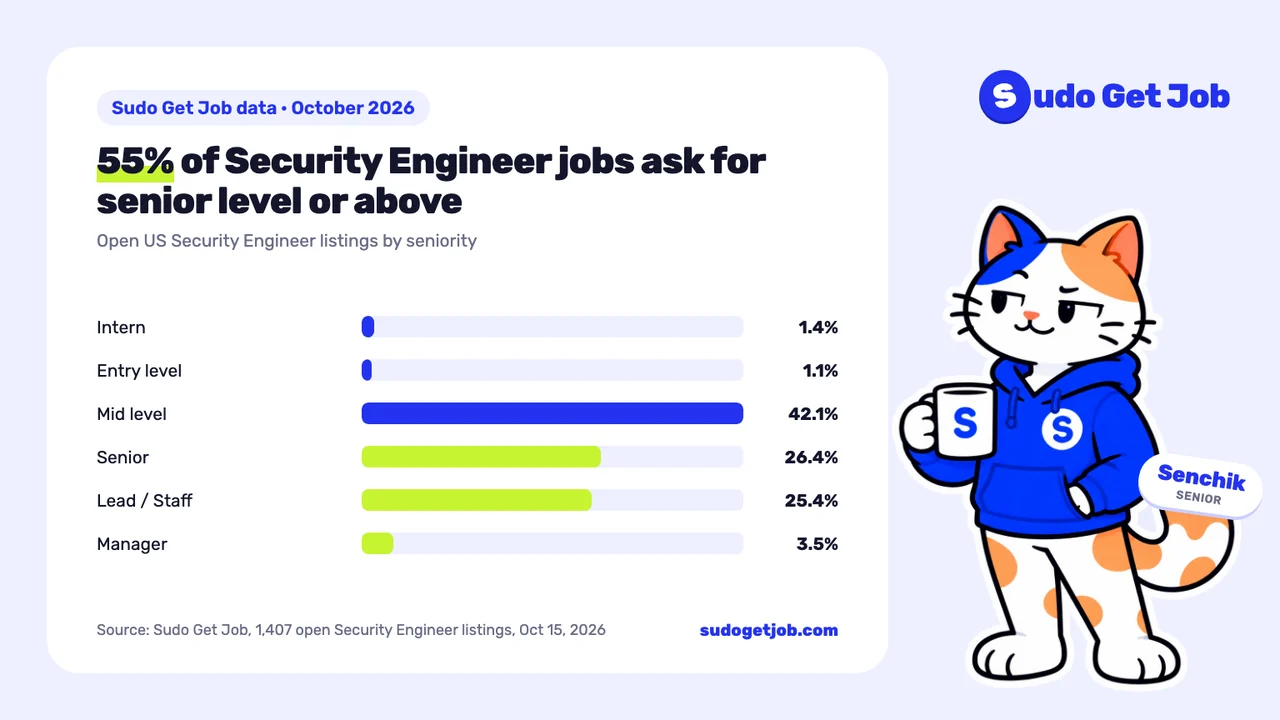
The panel above shows open Security Engineer listings right now. Use it to plan your search.
Cities
The city table shows where openings cluster. Washington, DC ranks near the top because of federal agencies and defense contractors. San Francisco and New York lead for tech and finance employers.
Clearance
About a third of Security Engineer listings on our board in October 2026 mentioned a security clearance. If you are a US citizen and open to government work, a clearance widens your options. If you are not eligible, filter those roles out early to save time.
Level
The level chart shows a market weighted toward experienced engineers. Mid-level, senior and lead roles make up most openings. Entry-level and intern roles are rare. Most people reach this role after working in IT, networking, software or a security operations center.
Pay
The median and the middle 50% come from salary ranges that employers posted. The Security Engineer salary page breaks them down by level and city.
Skills employers screen for
Postings list many tools and frameworks. Hiring decisions rest on a shorter list.
Cloud platforms
Most security work now happens in the cloud. AWS appeared in more than four out of ten Security Engineer listings on our board. Azure and GCP appeared in about a quarter each.
Learn one platform well:
- Identity and access management
- Network controls
- Logging
- Encryption
- The common ways accounts get misconfigured
Scripting and code
Python was the most common skill in our Security Engineer listings, at close to half. Go and Bash follow. Security engineers write scripts to automate checks, parse logs, call APIs and build small internal tools.
Infrastructure as code and pipelines
CI/CD appeared in about a third of our listings. Terraform and Kubernetes appear often too. DevSecOps and cloud security roles expect you to add security checks to pipelines, review infrastructure code and secure container platforms without slowing engineers down.
Vulnerability management and testing
Vulnerability management appeared in about a third of our listings. Learn how to find, rank and track fixes for weaknesses across many systems.
Threat modeling
Threat modeling appeared in more than a quarter of our listings. It means looking at a system design and asking what could go wrong, who would attack it and which controls matter most.
Detection and incident response
Incident response appeared in close to a third of our listings. Learn how a SIEM collects and searches logs and how an alert is triaged.
Learn what the steps of an incident are:
- 1
Detect
- 2
Contain
- 3
Remove
- 4
Recover
- 5
Review
Be ready to walk through an incident you handled or studied.
Identity and access
IAM appeared in about a quarter of our listings. Zero trust designs come up too. Learn single sign-on, multi-factor authentication, role-based access and how to review who has access to what.
Frameworks and compliance
NIST frameworks appeared in more than a quarter of our listings, especially in government and regulated industries. Some roles also mention SOC 2, ISO 27001, PCI DSS or FedRAMP.
Certifications
Security is one of the few tech fields where certifications appear often in job postings.
| Certification | Share of our Security Engineer listings, October 2026 |
|---|---|
| CISSP | Appeared in more than a quarter |
| CompTIA certifications | Appeared in close to one in five |
| GIAC certifications | Appeared in about one in eight |
Required or a plus
Read how each posting uses them. Some list a certification as required, often for government contracts. Others list it as a plus. A certification helps you pass a screen. It does not replace hands-on skill in interviews.
When to get one
If you are early in your career, an entry-level certification can help you get a first interview. CISSP requires several years of work experience, so it usually comes later.
Build proof of skill
Security hiring managers want to see what you can do with your hands.
- 1
Build a lab
Set up a small cloud account, deploy a few services, then attack and secure them. Write down each weakness you found and how you fixed it.
- 2
Write up your work
Publish short write-ups of lab exercises, capture-the-flag challenges or vulnerabilities you studied. Explain the cause, the impact and the fix. Clear writing is a large part of security work.
- 3
Build small tools
A script that checks cloud accounts for common misconfigurations or parses logs for suspicious events shows both coding and security skill. Put it on GitHub with a clear README.
- 4
Report vulnerabilities responsibly
Bug bounty programs let you test real systems with permission. A valid, well-written report is strong evidence. Test only systems that a program explicitly allows.
Write a security engineer resume
Lead with risk reduced
Each bullet should say what got safer: vulnerabilities fixed, controls added, incidents handled, access cleaned up, audits passed. Describe the scale: number of accounts, services or engineers affected.
Name the platforms and tools
Recruiters search for terms like "AWS", "Terraform", "SIEM", "threat modeling" or "CISSP". Use the exact words from the posting where they are true for you.
State clearance and certifications clearly
Put them near the top if you have them. Include the clearance level and status.
Keep it plain
One column, standard headings, no graphics. Do not include details that would expose a past employer's weaknesses.
Where to apply
Apply on the employer's site, and early
Every job here links to the employer's own application page. Sort by newest and filter for jobs posted in the last 7 days. Our report on how old open tech job posts are shows why freshness matters.
Decide on government work early
Defense contractors and federal agencies hire many security engineers, but clearance and citizenship rules apply. Commercial companies have different interviews and pay structures. Pick a lane for each application.
Look at regulated industries
Banks, insurers, healthcare systems and payment companies all hire security engineers. Their postings often mention specific frameworks.
Use referrals and community
Local security meetups and conferences are a common way to meet hiring managers. Ask people you know about their team before you ask for a referral.
How the interview process works
Security loops differ by specialty but usually include these stages.
Recruiter screen
Background, motivation, location, pay and, for government roles, clearance status. Have a short summary ready of your specialty and your strongest project.
Technical screen
Questions on networking, operating systems, web security and cloud basics. Common prompts:
- "What happens when you type a URL into a browser?" Expect follow-ups on DNS, TLS and HTTP.
- "How would you secure a new AWS account?"
- "Explain a common web vulnerability and how to prevent it."
Some companies add a scripting exercise, such as parsing a log file.
Hands-on or design round
Application security
For application security roles, you may review code for vulnerabilities or threat-model a system design.
Cloud and DevSecOps
For cloud and DevSecOps roles, you may design a secure architecture or a secure pipeline.
Detection
For detection roles, you may investigate a sample incident from logs.
Behavioral round
Stories about an incident, a disagreement with engineers about a fix, a risk you accepted and why, or a time you made security easier for others. Security engineers succeed by persuading, so show how you get teams to act.
Salary and negotiation
Use posted ranges
Several US states, including California, Colorado, Washington and New York, require pay ranges in job postings. Many security listings on our board include one. The range is base pay only.
Set your target by level and city
Use the Security Engineer salary page to see medians by level and metro. Check the remote security salary data if you are looking remotely.
Negotiate the whole offer
Bonus, equity, on-call pay, training budget and certification costs all matter. Ask about on-call duties before you accept.
Entry-level and career-switch paths
Direct entry-level security engineering jobs are rare. The usual routes are:
- 1
From IT
Start as an IT support specialist or systems administrator and take on security tasks.
- 2
From a security operations center
Start as a cybersecurity analyst in a security operations center and move toward engineering.
- 3
From engineering
Start as a network engineer, DevOps engineer or software engineer and specialize in security for that area.
- 4
From military or government service
Serve in a military or government role that includes security work, which can also bring a clearance.
Finding a remote role
Remote security engineering jobs exist, mostly at commercial companies. See all remote Security Engineer jobs.
Our report on where remote tech jobs are shows how security compares with other roles.
A short checklist
- Choose your specialty: cloud, application, DevSecOps, detection or identity.
- Decide whether you will apply to roles that require a clearance.
- Set a salary range from the median for your level and city.
- Build a lab and publish a few clear write-ups.
- Rewrite your resume around risk reduced, platforms and scale.
- List clearance and certifications near the top.
- Apply early on employers' own sites, and ask for referrals.
- Practice networking, web security and cloud questions out loud.
- Practice threat modeling on a system you know.
- Ask about on-call duties, then negotiate the full offer in writing.
Start with the current Security Engineer jobs, newest first.