
What the job is
A systems administrator keeps an organization's servers, accounts and core services running. That includes Windows and Linux servers, virtual machines, identity systems, email, file storage, backups and patching. When something breaks below the level of a single laptop, the sysadmin is usually the person who fixes it.
Three parts of the job
The job has three parts.
Keep systems healthy
You keep systems healthy with patches, updates and monitoring.
Make changes safely
You make changes safely, such as adding a server or migrating a service.
Respond to failures
You respond when something fails, often under time pressure.
Job titles to search
Over the last decade, a lot of this work has moved to the cloud and to automation. The title has changed with it. Search for all of these:
- Systems Administrator, System Administrator, Linux Systems Administrator, Windows Systems Administrator
- IT Systems Engineer, IT Engineer, IT Operations Engineer
- Infrastructure Administrator, Server Administrator
- Junior Systems Administrator for entry roles
The Systems Administrator market now
Work format
- On-site 81%
- Hybrid 12%
- Remote 7%
Openings by level
Where the jobs are




Read the market before you apply
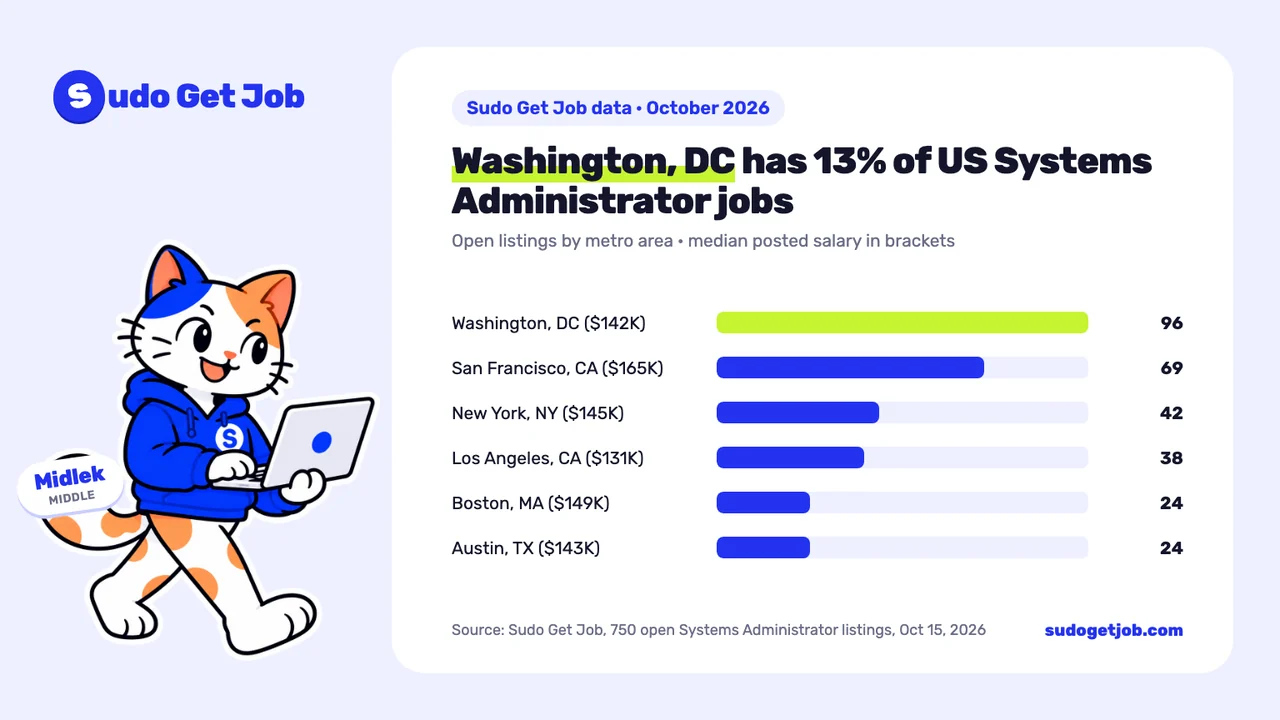
The panel above shows open Systems Administrator listings right now. Use it to plan your search.
Employers
Federal and defense contractors often fill most of the hiring table for this role. When we checked our listings in October 2026, about half of systems administrator postings mentioned a security clearance. That is the highest share among the IT roles in this guide series. Cleared roles usually require US citizenship.
Cities
The Washington, DC metro usually leads the city table, because of federal work. Sysadmin jobs also exist in many smaller locations near bases, labs and plants. Look at the full list of metros, not only the top rows.
Format
Sysadmin work is mostly on-site. Servers, secure networks and classified systems often require you to be in the building. The remote share in the panel is small. Plan your search around places you can reach.
Pay
The median and the middle 50% come from salary ranges that employers posted. The Systems Administrator salary page shows the same numbers by level and city.
Skills employers screen for
Linux
Linux was named in about half of our sysadmin listings when we checked. It was the skill named most often.
Learn the command line well:
- Users and permissions
- Services with systemd
- Package management
- Disk and file systems
- Logs, cron and SSH keys
Windows Server and Active Directory
Active Directory appeared in more than a third of listings. Windows Server in about a quarter. Learn domains, organizational units, group policy, DNS and DHCP on Windows, and how authentication works between them.
Scripting and automation
Employers expect sysadmins to automate.
| Tool | Share of listings when we checked |
|---|---|
| PowerShell and Bash | Each appeared in about three in ten listings |
| Python | Appeared in about a third |
| Ansible | Appeared in about one in five and is the most common configuration tool in these postings |
Learn to write a script that is safe to run twice and that logs what it changed.
Virtualization and cloud
VMware
VMware appeared in about a quarter of listings. Learn how virtual machines, hosts, storage and snapshots work together.
Networking
You do not need to be a network engineer. You need to troubleshoot.
- Know DNS well, since many outages start there.
- Know TCP/IP, subnets, routing basics, firewalls and VPNs.
Identity and security
Sysadmins hold the keys. Postings often mention identity and access management, single sign-on, Okta, Intune for device management and vulnerability management for patching.
Backups and recovery
Documentation and change control
Good sysadmins write things down: runbooks, diagrams, change records. Many organizations require approved changes before work on production systems. Show that you respect the process and can explain why it exists.
Certifications
Certifications matter in this role, especially in government work.
CompTIA
The CompTIA certifications appeared in about a third of our sysadmin listings when we checked. Security+ was named far more often than any other single certification in these listings. Network+ and Linux+ also appear.
Other useful certifications
RHCSA
Red Hat Certified System Administrator (RHCSA) for Linux-heavy roles.
Microsoft
Microsoft certifications for Azure and Windows administration.
AWS
AWS certifications for cloud-heavy roles.
VMware
VMware certifications where the posting names VMware.
Build proof of skill
- 1
Run a home lab
Use an old PC or free-tier cloud resources. Build a small domain with a Windows Server, a Linux server and a client. Set up DNS, file sharing, a web server and backups.
- 2
Automate the lab
Rebuild it from scripts or Ansible playbooks. Being able to destroy and recreate your lab in minutes is strong proof of automation skill.
- 3
Break it and fix it
Fill a disk, stop a service, break DNS. Practice finding the cause from logs. Write down each problem and fix as a short runbook.
- 4
Publish the work
Put the scripts and runbooks on GitHub with a clear README. This shows how you document, which is a large part of the job.
Write a resume that survives screening
Keep the format plain
One column, standard headings, a common font. Parsing software skips tables and images.
Put certifications and clearance near the top
Recruiters for contractor roles filter on both. State your clearance level and status accurately.
Describe the environment
Say how many servers, users or sites you supported, and on what platforms. "Administered 120 Linux and Windows servers across two data centers" sets your scope in one line. Use numbers you actually know.
Show automation and results
"Automated monthly patching with Ansible, cutting the maintenance window from a weekend to one evening" is the kind of bullet that stands out.
Match the posting's words
If the posting names RHEL, VMware and Active Directory, use those exact terms where they are true for you.
Where to apply
Apply on the employer's site, and early
Every job on our board links to the employer's own application page. Sort by newest and filter for jobs posted in the last 7 days. Our report on how old open tech job posts are shows why freshness matters.
Look at the full range of employers
Besides contractors, universities, hospitals, school districts, manufacturers, banks and local governments all employ sysadmins. Many of these jobs are stable and less competitive than tech company roles.
Read clearance requirements closely
Some postings require an active clearance on day one. Others accept candidates who can obtain one. Apply to the second kind if you do not hold one yet.
Use your network
Contractor hiring often moves through referrals between people who worked on the same programs. Former colleagues are your best source of leads.
How the interview process works
Sysadmin interviews focus on practical knowledge and judgment.
Recruiter screen
Background, clearance, certifications, location, shift and pay. Ask about on-call and maintenance windows. Many sysadmin roles include evening or weekend work.
Technical interview
Expect direct questions and troubleshooting scenarios. Common examples:
- A user cannot log in to a domain-joined machine. What could cause it?
- A Linux server is slow. How do you find out why?
- A website on your server stopped responding. Walk me through your checks.
- How would you patch a hundred servers with minimal downtime?
- How do you know your backups work?
Practical test
Some employers give a hands-on task in a lab: configure a service, fix a broken server or write a short script. Talk through what you are doing.
Behavioral and manager interview
Expect questions about outages, mistakes, pressure and working with security or compliance teams. Prepare a story about a change that went wrong and what you did next. Interviewers want to hear that you communicated early and learned from it.
Salary and negotiation
Know what the ranges mean
Several US states, including California, Colorado, Washington and New York, require pay ranges in job postings. Contractor ranges are often wide because one posting covers several levels. The range is base pay.
Set your number from data
Use the Systems Administrator salary page to see the median and middle 50% for your level and city.
Know what a clearance is worth to you
Cleared roles are harder to fill. If you hold an active clearance, factor that into your ask. Also ask about shift differentials, on-call pay and paid certification training.
Entry-level and career-switch paths
Most sysadmins start in support. The usual path:
- 1
Start in IT support or the help desk. See our IT Support Specialist guide.
- 2
Take on server tasks: account management, patching, backups, small migrations.
- 3
Apply for junior sysadmin roles once you can describe a few of those tasks in detail.
Finding a remote role
Remote sysadmin jobs are a small share of this market. See all remote Systems Administrator jobs and the remote salary data.
Most are at companies that run fully in the cloud and have no data center.
A short checklist
- Decide between Linux-heavy, Windows-heavy and mixed roles.
- Decide whether you will pursue cleared roles.
- Set a salary range from the median for your level and city.
- Earn the certification your target postings require, often Security+.
- Build a home lab and rebuild it from scripts.
- Rewrite your resume around environment size, automation and results.
- Apply early on employers' own sites, including employers outside tech.
- Practice troubleshooting scenarios out loud.
- Prepare a story about an outage or a change that went wrong.
- Ask about on-call, maintenance windows and training before you accept.
Start with the current Systems Administrator jobs, newest first.