
What the job is
A site reliability engineer, or SRE, keeps production systems fast and available. The SRE treats operations as a software problem.
Four areas of work
Most SRE work falls into four areas:
Monitoring
Deciding what to measure, setting alerts that matter and cutting alerts that do not.
Incident response
Being on call, leading the response when something breaks and writing the review afterwards.
Automation
Replacing manual work with tools: deployments, scaling, failover, routine fixes.
Capacity and design
Making sure systems can handle growth and helping product teams design services that fail safely.
Service level objectives
Job titles to search
Titles vary. Search for all of these:
- Site Reliability Engineer, SRE II, Senior or Staff SRE
- Infrastructure Engineer, Cloud Infrastructure Engineer
- Production Engineer, used at some large tech companies
- Platform Engineer, where the team builds internal tools for other engineers
- AI Infrastructure Engineer, for teams running large model training and serving
SRE and DevOps
The line between SRE and DevOps engineer is blurry.
DevOps
DevOps roles usually focus more on build and release pipelines.
SRE
SRE roles focus more on production reliability and on-call.
Check cloud engineer roles too if you like infrastructure work.
The Site Reliability Engineer market now
Work format
- On-site 63%
- Hybrid 21%
- Remote 16%
Openings by level
Where the jobs are






Read the market before you apply
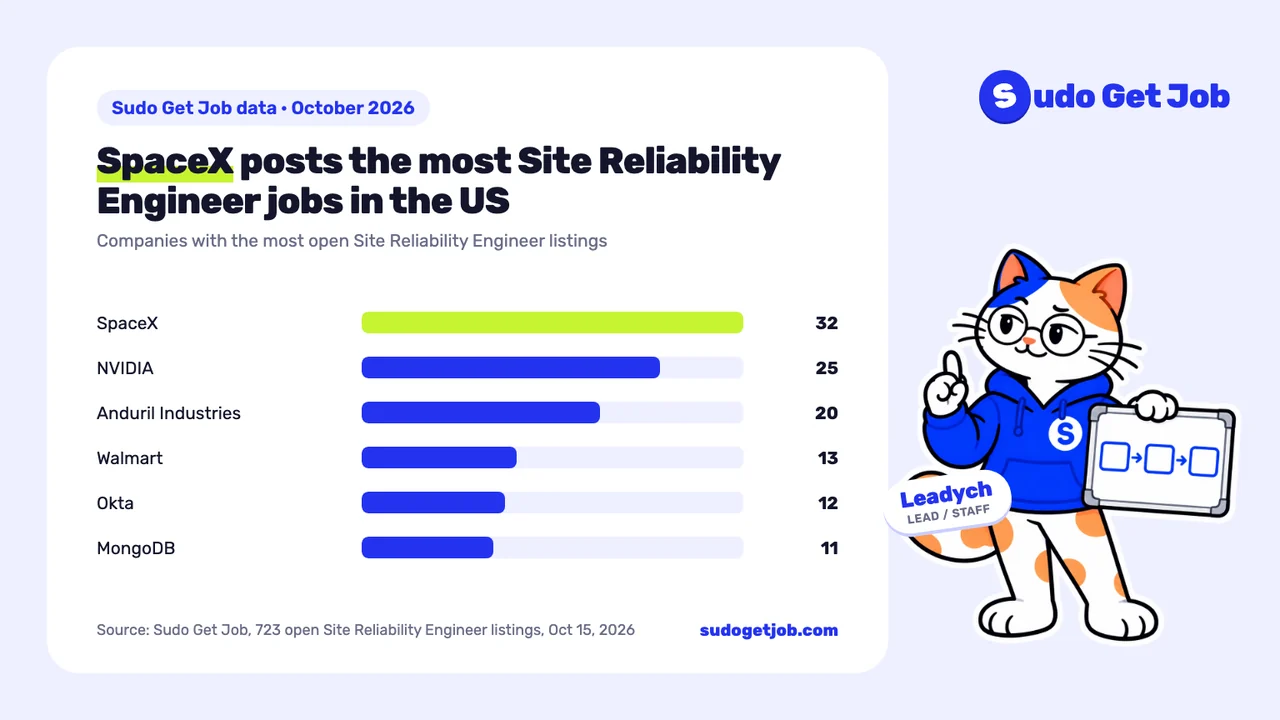
The panel above shows open Site Reliability Engineer listings right now. Use it to plan your search.
Cities
SRE roles cluster in large tech metros. San Francisco usually leads the city table, followed by New York, Washington, DC and Seattle. Check the remote share and the hybrid roles if you need to stay where you live.
Level
The level chart shows the mix. SRE hiring leans toward mid-level and senior engineers. Entry and intern roles are a small share. Most SREs come to the role after working as a software engineer or a systems administrator.
Employers
The hiring table shows which companies post the most SRE roles. It often includes aerospace and defense firms, cloud and AI infrastructure companies, and large retailers and banks.
Pay
The median and the middle 50% come from salary ranges that employers posted. Open the Site Reliability Engineer salary page to see the same numbers by level and city.
Skills employers screen for
SRE postings combine software and operations. Most hiring decisions rest on the skills below.
Coding
SREs write real code. Python was named in about six in ten of our SRE listings when we checked. Go appeared in about a third. You should be able to write a clean tool in one of them, with tests.
Linux and networking
Linux appeared in about a third of SRE listings.
Linux
Learn processes, memory, file systems, system calls and how to debug a slow or stuck process.
Networking
Know DNS, TCP, load balancers and TLS. Many incidents come down to one of these.
Containers and Kubernetes
Kubernetes appeared in more than half of our SRE listings when we checked.
- Learn how pods, deployments, services and ingress fit together.
- Know how to find out why a pod keeps restarting and how resource limits affect scheduling.
Docker, Helm and Argo CD appear often alongside it.
Cloud and infrastructure as code
| Skill | How often it appeared in SRE listings |
|---|---|
| AWS | About half |
| Azure and GCP | Each about a quarter |
| Terraform | Close to half |
SREs manage infrastructure in code, review it like code and deploy it through a pipeline. Learn how to structure Terraform for several environments and how to change shared infrastructure safely.
CI/CD
CI/CD appeared in about four in ten listings. Know how a change moves from a merge to production.
Learn safe release patterns:
Canary releases
Gradual rollouts
Feature flags
Fast rollback
Observability
SREs decide what to measure. Learn metrics, logs and traces, and when each one helps.
Incident response
Incident response appeared in about a third of SRE listings. When we checked, a similar share of SRE postings mentioned on-call work directly.
Learn how an incident is run:
One person leads
Others investigate
Someone communicates
Learn how to write a blameless review that finds the cause in the system, not in a person.
Distributed systems
Distributed systems appeared in close to three in ten listings.
- Know why retries can make an outage worse
- How timeouts should be set
- What happens when a dependency is slow rather than down
Build proof of skill
Reliability work is hard to show without production access. These projects come close.
- 1
Run a small service like production
Deploy a simple app to a Kubernetes cluster you built with Terraform. Add a CI/CD pipeline, health checks, metrics, dashboards and alerts. Set a service level objective and measure it.
- 2
Break it on purpose
Kill a node, fill a disk, add latency to a dependency. Watch what your alerts do. Write a short incident review for each test: what happened, how you noticed, how you fixed it, what you changed.
- 3
Automate a toil task
Pick a manual operations task you know from work or your lab and write a tool that does it. Include tests and a README.
- 4
Contribute to infrastructure open source
Small fixes to tools you use, such as a Terraform provider, a Helm chart or a monitoring exporter, show that you can work in a real codebase.
- 5
Write about an incident you handled
If your past work is private, describe one incident in general terms on a personal page: the symptom, the investigation, the cause and the fix.
Write a resume that survives screening
- Keep the format plain One column, standard headings, a common font. Parsing software skips tables, graphics and text in images.
- Lead with reliability results Good SRE bullets name what improved: fewer pages, faster deployments, faster recovery, lower cost, higher availability. Use numbers you actually know.
- Show automation "Replaced manual failover with an automated runbook, cutting recovery from an hour to minutes" tells a reviewer what you built and why it mattered.
- Name the stack If the posting says Kubernetes, Terraform, AWS and Prometheus, use those exact words where they are true for you.
- Show on-call experience Say how big the rotation was and what systems you covered. Mention incidents you led.
Where to apply
Apply on the employer's site, and early
Every job on our board links to the employer's own application page. Sort by newest and filter for jobs posted in the last 7 days. Our report on how old open tech job posts are shows why freshness matters.
Search by stack
If you know the tools well, search them directly: Kubernetes jobs or Terraform jobs. Many infrastructure roles do not use the SRE title.
Look at all kinds of employers
Banks, retailers, aerospace firms and government contractors run large systems too. Cleared SRE roles exist too, and the Washington, DC metro has the most of them.
Ask for referrals
Infrastructure teams are often small. A referral from an engineer on the team usually gets your resume read by the hiring manager.
How the interview process works
SRE loops combine software engineering and operations rounds.
Recruiter screen
Background, location, level, on-call expectations and pay. Ask how on-call works: rotation size, hours and compensation.
Technical screen
Usually a coding exercise. It may be a general algorithm problem or a practical task, such as parsing a log file and reporting the slowest endpoints. Some companies ask Linux and networking questions in this round.
Onsite or final loop
A typical SRE loop includes:
Coding
Similar to the screen, sometimes harder.
Troubleshooting
The interviewer describes a broken system and answers your questions. "Users report errors on checkout. What do you check?" Work from symptoms to cause. Say what you would look at and why.
System design
Design a service with a focus on reliability: monitoring, failover, capacity and deployment. Common prompts are a monitoring system, a deployment system or a highly available version of a common service.
Behavioral
Stories about incidents, on-call stress, disagreements with product teams and reducing toil.
Salary and negotiation
Know what the ranges mean
Several US states, including California, Colorado, Washington and New York, require pay ranges in job postings. The range is base pay. Bonus, equity and on-call pay vary between companies.
Set your number from data
Use the Site Reliability Engineer salary page to see the median and middle 50% by level and city. Check the remote SRE salary data if you search remotely.
Ask about on-call
On-call is part of the job. Ask how often you will be on call, how many pages a week the rotation gets and whether on-call is paid. A quiet rotation is worth as much as a raise.
Negotiate the whole offer
If base pay is fixed, ask about signing bonus, equity, level or start date. Ask in writing.
Breaking in at entry level
Few people start their career as an SRE. The common paths are:
- 1
From software engineering
Join a team that runs its own services. Volunteer for on-call, deployment tooling and monitoring. See our Software Engineer guide and our Backend Developer guide.
- 2
From systems administration
Add coding and cloud skills to your operations background. Automate everything you can. See our Systems Administrator guide.
- 3
From DevOps or cloud roles
Move closer to production reliability and incident work.
- 4
Through new-grad programs
Some large companies hire SREs out of school. These programs are few, so apply widely.
Finding a remote role
Remote SRE jobs exist, especially at cloud-native companies. See all remote Site Reliability Engineer jobs.
Our report on where remote tech jobs are shows how SRE compares with other roles.
A short checklist
- Decide which path you come from: software, systems or DevOps.
- Pick the cities, or remote, where you will search.
- Set a salary range from the median for your level and city.
- Build a small service with Terraform, Kubernetes, CI/CD, metrics and alerts.
- Break it on purpose and write incident reviews.
- Rewrite your resume around reliability results, automation and on-call.
- Apply early on employers' own sites, searching by stack as well as title.
- Practice coding, troubleshooting and reliability-focused system design.
- Prepare stories about incidents and reducing toil.
- Ask about on-call before you negotiate the offer.
Start with the current Site Reliability Engineer jobs, newest first.